
25 Bible Verses About Anger: Self-Control, Forgiveness & Peace
When anger rises, Scripture gives more than a command to “calm down.” It shows how to slow the reaction, examine the heart, speak truth without retaliation, forgive wisely, and leave final judgment with God.
Quick Answer
The Bible takes anger seriously because unchecked anger can produce harmful words, revenge, division, and foolish choices. James 1:19–20, Proverbs 15:1, Proverbs 14:29, Ephesians 4:26–32, Psalm 37:8, and Proverbs 16:32 are strong starting passages. Scripture recognizes that anger can signal that something is wrong, but it calls believers to respond with self-control, truth, forgiveness, and wise action rather than retaliation.
Don’t wait until after the words are spoken.
When frustration builds, remembering the right Scripture in the moment can be difficult. Keep God’s Word somewhere visible so you have something better to return to before anger chooses your next words.
A full BiblePrints Scripture collection for everyday faith, including verses you can return to for self-control, forgiveness, peace, courage, and encouragement. It is not an anger-only card pack.
Translation note: Passage explanations below are written in original wording. Exact quotations are from the public-domain World English Bible (WEB) where identified. Read each reference in its surrounding chapter and in your preferred Bible translation.

What Does the Bible Say About Anger?
The Bible does not treat every experience of anger as identical. It warns about anger that controls speech, feeds resentment, seeks revenge, or becomes a repeated pattern. At the same time, Scripture describes God as “slow to anger” and explicitly shows Jesus looking on hard-heartedness with anger and grief in Mark 3:5. The question is therefore not only, “Am I angry?” but also, “What is this anger producing, and what response is faithful now?”
James 1:19–20 gives a clear first response: listen quickly, speak slowly, and become slow to anger because human anger does not produce God’s righteousness. Proverbs adds that patience reflects understanding, a gentle answer can lower conflict, and self-control is stronger than outward power. Scripture’s direction is active: identify what happened, guard your words, seek what is true, repair what you can, and refuse personal vengeance.
If anger is connected to relational conflict, the broader guidance in Bible verses about relationships can help you think about communication, trust, forgiveness, and healthy boundaries without reducing every problem to “just be more patient.”
Which Bible Verse Fits the Anger You’re Facing Right Now?
Choose the passage that addresses the immediate job you need Scripture to do. A verse for stopping an outburst serves a different purpose from a passage about repairing trust after harm.
| When you are… | Start with… | Why it fits | Practice it by… |
|---|---|---|---|
| About to react | James 1:19–20 | It links listening, speech, anger, and God’s righteousness. | Pause long enough to hear the whole sentence before answering. |
| In a heated conversation | Proverbs 15:1 | It treats tone as part of the response. | Lower your volume and answer the issue rather than attacking the person. |
| Holding resentment | Ephesians 4:31–32 | It names bitterness and gives a replacement pattern: kindness and forgiveness. | Confess your own wrong response and choose one honest repair step. |
| Tempted to get even | Romans 12:19–21 | It leaves vengeance with God and redirects evil toward faithful good. | Stop the revenge plan and choose a safe, truthful, constructive action. |
| Feeling powerless | Proverbs 16:32 | It defines ruling your spirit as real strength. | Measure victory by restraint and wisdom, not by winning the argument. |
Bible Verses About Anger and Self-Control
These passages are especially useful when you are looking for Bible verses for controlling anger. They do not promise that one reading will erase every strong emotion. They give language for a repeatable response: slow down, restrain speech, refuse escalation, and let God reshape the character behind the reaction.
1. Listen before you answer
“So, then, my beloved brothers, let every man be swift to hear, slow to speak, and slow to anger; for the anger of man doesn’t produce the righteousness of God.”
Key idea: The order matters. Listening comes before speech, and restrained speech creates room for a response that reflects God’s righteousness.
Context and use: James writes to believers facing trials and temptation, calling them toward an obedient response to God’s Word. Use this passage before replying to a text, comment, spouse, coworker, or family member.
2. Patience shows understanding
“He who is slow to anger has great understanding, but he who has a quick temper displays folly.”
Key idea: A delayed reaction can be a sign of wisdom; speed is not the same as strength.
Best use: Keep this verse for moments when you want to answer immediately. Ask, “What might become clearer if I wait before responding?”
3. Gentle words can lower the heat
“A gentle answer turns away wrath, but a harsh word stirs up anger.”
Key idea: A gentle answer is not surrender or dishonesty. It is a deliberate choice not to add needless force to a difficult conversation.
Practical use: Replace “You always…” with a specific observation: “When that happened, I felt hurt. Can we talk about what happened?”
4. Self-control is strength
“One who is slow to anger is better than the mighty; one who rules his spirit, than he who takes a city.”
Key idea: Scripture measures strength by the ability to govern the self, not by the ability to overpower another person.
Practice: When you successfully pause, count that as progress even if the situation remains unresolved.
5. Turn away from wrath
“Cease from anger, and forsake wrath. Don’t fret; it leads only to evildoing.”
Key idea: Anger becomes especially dangerous when repeated mental replay keeps supplying it with fuel.
Context and use: Psalm 37 tells God’s people not to fret over wrongdoers who seem to prosper. Turning away from wrath means refusing to let another person’s apparent success in wrongdoing direct your own heart toward evil.
6. Do not make an outburst your outlet
“A fool vents all of his anger, but a wise man brings himself under control.”
Key idea: Expressing every impulse is not the same as honest communication. Wisdom creates enough space to choose words that can actually help.
Best use: Memorize the contrast before a recurring argument, then write the one sentence you need to say without adding insults.
7. Refuse the quick temper
Key idea: Ecclesiastes warns against becoming quickly provoked and letting anger settle into the heart.
Best use: Use this passage when irritation keeps returning long after the original moment has passed.
8. Let self-control grow as fruit
Key idea: Patience, gentleness, and self-control are presented as fruit of the Spirit—not merely techniques for appearing calm.
Long-term use: Pair anger-specific verses with prayer and repeated habits rather than expecting a single verse to function like an instant emotional switch.
For a broader collection of compact passages you can keep nearby, see short Bible verses. The goal is not to collect references without reading them; it is to choose one passage and return to it long enough for the words to shape a real response.

5 Short Bible Verses About Controlling Anger to Remember
If you need a short passage you can recall before speaking, begin with these five. Each addresses a different part of the anger cycle.
Bible Verses About Anger and Forgiveness
Forgiveness is central to the Bible’s answer to anger, but forgiveness is not the same as declaring harm acceptable, restoring trust instantly, or removing every wise boundary. A person may choose forgiveness while painful emotions still take time to settle. Reconciliation may also require truth, repentance, changed behavior, time, and safety.
9. Replace bitterness with kindness
“Be angry, and don’t sin.” … “Let all bitterness, wrath, anger, outcry, and slander be put away from you, with all malice. And be kind to one another, tender hearted, forgiving each other, just as God also in Christ forgave you.”
Key idea: Paul moves from anger to the patterns it can become—bitterness, destructive speech, and malice—then gives a replacement: kindness, tenderheartedness, and forgiveness.
Responsible use: “Don’t let the sun go down on your wrath” urges prompt attention to anger; it does not require an unsafe confrontation at night or force a harmed person to settle a serious issue before they are ready and supported.
10. Overlook what does not require escalation
Key idea: Wisdom helps distinguish a minor offense that can be released from a serious pattern that needs a truthful response.
Practice: Before reopening a small irritation, ask whether bringing it up will restore understanding or merely keep the other person on trial.
11. Forgive from a changed posture
“Put on therefore, as God’s chosen ones, holy and beloved, a heart of compassion, kindness, lowliness, humility, and perseverance; bearing with one another, and forgiving each other…”
Key idea: Forgiveness belongs with compassion, humility, perseverance, and bearing with one another; it is not a performance that denies pain.
12. Leave revenge with God
“Repay no one evil for evil.” … “If it is possible, as much as it is up to you, be at peace with all men.” … “Don’t be overcome by evil, but overcome evil with good.”
Key idea: Christians are responsible for their own faithful response while God remains judge. “As much as it is up to you” recognizes that peace cannot be controlled by one person alone.
Important distinction: Refusing revenge does not remove the need to report wrongdoing, seek protection, or involve appropriate authorities when someone is unsafe.
Readers working through emotional overload may also find Bible verses for feeling overwhelmed useful for related prayer and reflection. Anger and overwhelm can overlap, but they are not the same problem; choose the passage that names your actual need.
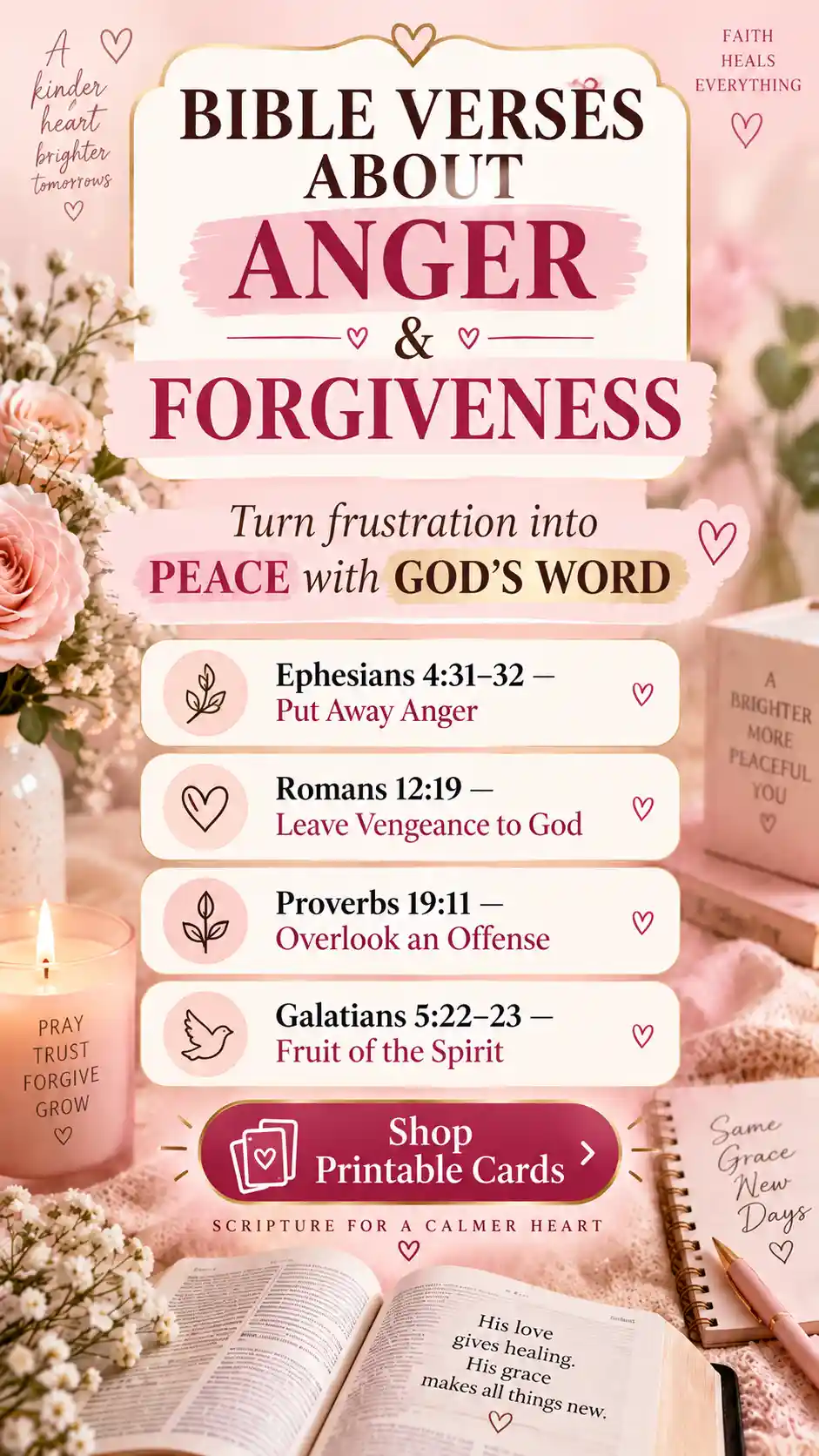
Righteous Anger, Sinful Anger, Revenge, and Wise Boundaries
Scripture includes examples of God’s judgment and explicitly describes Jesus looking at hard-heartedness with anger and grief in Mark 3:5, so the Bible does not require believers to call evil good. Yet a legitimate concern does not automatically make every angry response righteous. You can be angry about a real wrong and still respond with pride, cruelty, exaggeration, or revenge.
A 5-Part Biblical Test for the Anger You Feel
Object: Is there a real wrong, or mainly a wounded preference? Posture: Am I grieved by harm or mainly offended that I did not get my way? Response: Am I seeking truth and protection, or punishment and humiliation? Duration: Am I addressing the issue or feeding resentment? Fruit: Is this producing love, wisdom, justice, and self-control—or bitterness, contempt, gossip, and revenge?
13. Mark 3:5 — Jesus’ anger was joined with grief
Mark describes Jesus looking at people with anger while grieving their hardness of heart. That combination matters: biblical concern for wrong is not the same as delighting in another person’s humiliation.
14. Romans 12:19–21 — Justice is not personal revenge
Romans refuses retaliation while still taking evil seriously. Releasing vengeance means refusing to become the final judge yourself; it does not mean pretending injustice never happened.
15. Ephesians 4:26–27 — Anger needs boundaries
“Be angry, and don’t sin” is not permission to nourish anger indefinitely. The surrounding passage pushes toward truthful speech, useful words, kindness, and forgiveness rather than bitterness.
16. Psalm 103:8 — God is slow to anger
Scripture repeatedly describes God as merciful, gracious, and slow to anger. Divine anger is not portrayed as impulsive or uncontrolled; that gives believers a better model than simply assuming every intense feeling is justified.
17. Exodus 34:6 — Mercy and patience belong to God’s revealed character
This repeated description of God helps frame the Bible’s call to patience: strength and holiness are not shown through a short fuse.
Forgiveness and trust are related, but different
You can release vengeance while still requiring honesty, distance, accountability, or changed behavior. In a relationship marked by coercion, threats, or abuse, do not use Bible verses about patience or forgiveness to pressure yourself or anyone else to remain in danger.
More Bible Questions About Anger
People often search for anger verses by situation. These study paths point to the next passages to read without treating a single verse as the complete answer.
18. Anger in relationships
Start with Ephesians 4:29, Ephesians 4:31–32, Proverbs 15:1, and Proverbs 15:18. Ask how your words affect the other person, then name the issue clearly and choose a repair step. Continue with Bible verses about relationships.
19. Anger, frustration, and emotional heaviness
Read Psalm 42, Psalm 62:8, and Philippians 4:6–8 alongside the anger passages. Lament gives pain an honest voice while prayer turns the heart toward God. If anger is mixed with feeling overwhelmed, continue with Bible verses for feeling overwhelmed.
20. Anger verses in Proverbs
Study Proverbs 14:29, 15:1, 15:18, 16:32, 19:11, 22:24–25, and 29:11. Together they connect patience, tone, friendships, self-rule, overlooking an offense, and the consequences of a hot temper.
21. Anger in the New Testament
Read Matthew 5:21–24; Mark 3:5; James 1:19–20; Ephesians 4:26–32; Colossians 3:8–13; Romans 12:17–21; and Galatians 5:22–23. The repeated direction is truthful action shaped by love, patience, gentleness, and self-control.
22. Cain: anger that became violence
Genesis 4:5–8 shows Cain angry after his offering was not regarded. God confronts him before the murder, warning him that sin is crouching at the door. The story is a severe picture of anger that refuses correction.
23. Moses: provocation and rash words
Numbers 20:10–12 records Moses striking the rock in disobedience. Psalm 106:32–33 later describes the episode in terms of provocation and rash speech, making it a useful warning about how pressure can distort words and actions.
24. Saul: jealousy that kept escalating
1 Samuel 18–20 shows Saul’s jealousy and anger toward David growing into hostility and repeated violence. Anger that is fed rather than examined can distort judgment and relationships over time.
25. Ephesians 4:31–32 — replace, don’t merely suppress
The New Testament does not only tell believers what to remove. It gives replacement practices: kindness, tenderheartedness, forgiveness, truthful speech, and words that build others up.
5 Biblical Steps to Control Anger Before You React
This routine combines the major themes above. It is a practical framework for ordinary conflict, not a substitute for pastoral, professional, legal, or emergency help when a situation is dangerous or out of control.
How to memorize one anger verse
Choose one passage for seven days. Read it aloud in the morning, write the reference once, try to recall the key line before checking it, and read the surrounding chapter during the week. Place the reference where an argument normally begins—your phone lock screen, desk, car, or Bible. A printable card can make the cue visible, but the goal is understanding and practicing the Word.
If you want more Scripture for daily encouragement and steady faith, explore encouraging Bible verses alongside this anger-focused guide.
A Short Prayer for Anger, Self-Control, and Forgiveness
God, you know the hurt and frustration beneath my anger. Give me wisdom to listen before I speak, courage to address what is wrong, and self-control when I want to retaliate. Show me where I need to confess, apologize, or set a wise boundary. Help me forgive without calling harm good, and leave final judgment in your hands. Teach me to answer with truth, gentleness, and love. Amen.
Frequently Asked Questions About Anger in the Bible
What is the best Bible verse for anger?
James 1:19–20 is one of the strongest starting passages because it directly connects listening, speech, anger, and God’s righteousness. Proverbs 15:1 is especially useful during a heated conversation, while Ephesians 4:26–32 addresses unresolved anger, bitterness, and forgiveness.
How do you biblically fight anger?
Begin by slowing the reaction: listen before speaking (James 1:19), choose a gentle answer (Proverbs 15:1), practice self-control (Proverbs 16:32), refuse personal revenge (Romans 12:19–21), and deal honestly with lingering bitterness and forgiveness (Ephesians 4:26–32).
What does Psalm 37 say about anger?
Psalm 37:8 tells the reader to cease from anger and forsake wrath because fretting can lead toward wrongdoing. The wider psalm addresses the temptation to fret over wrongdoers who seem to prosper and redirects the reader toward trusting God rather than letting another person’s apparent success fuel sinful response.
What does Proverbs 14:29 say about anger?
Proverbs 14:29 connects being slow to anger with great understanding and contrasts it with a quick temper that displays folly. The verse treats restraint as wisdom, not weakness.
What does Jesus say about anger?
In Matthew 5:21–24, Jesus treats anger, contempt, and broken relationships with serious moral weight and points toward reconciliation. Mark 3:5 also explicitly describes Jesus looking at hard-heartedness with anger and grief, showing that anger at real wrong is not the same thing as personal rage or revenge.
Does the Bible say that anger is always a sin?
No. Ephesians 4:26 acknowledges anger while commanding believers not to sin. Scripture evaluates what anger does and where it leads. Even anger about a genuine wrong still requires truthful, controlled action rather than cruelty or revenge.
What does the Bible say about controlling anger?
The Bible repeatedly calls people to be slow to anger, careful with words, patient, self-controlled, and willing to turn away from wrath. James 1:19–20, Proverbs 14:29, Proverbs 15:1, Proverbs 16:32, Proverbs 29:11, and Psalm 37:8 are especially useful passages to study and practice.
What does the Bible say about anger and forgiveness?
Ephesians 4:31–32 and Colossians 3:12–13 connect putting away bitterness with kindness, compassion, perseverance, and forgiveness. Forgiveness rejects personal revenge; it does not automatically restore trust or remove wise boundaries after serious harm.
What is the “be angry and do not sin” verse?
Ephesians 4:26 says, “Be angry, and don’t sin.” The surrounding verses warn against letting anger linger and move toward destructive speech, bitterness, and malice. The passage acknowledges anger while placing clear limits on how believers respond to it.
What should I do when someone else is angry at me?
Where it is safe, listen for the actual issue, answer gently, and avoid returning insult for insult. If the person is threatening, violent, coercive, or abusive, prioritize safety, involve trusted support, and seek qualified local help rather than confronting the situation alone.
Can I forgive someone and still keep a boundary?
Yes. Biblical forgiveness and restored trust are not identical. You can refuse revenge while still requiring honesty, changed behavior, accountability, distance, or outside help. A boundary can protect people while you continue to act without hatred.
Pingback: Journaling Bible Guide: How to Choose & Start Bible Journaling