
25 Bible Verses for Kindergarteners: Short, Easy Scriptures Kids Can Learn
Looking for Bible verses a kindergarten-age child can actually understand, remember, and use? This guide goes beyond a long list of quotations. It helps parents, grandparents, homeschool families, and children's ministry teachers choose Scripture for real moments like fear, kindness, school, bedtime, gratitude, prayer, and learning to trust God.
Some of the best Bible verses for kindergarteners are Genesis 1:1, Psalm 56:3, Luke 6:31, Ephesians 4:32, and Philippians 4:4 because each centers on one clear idea a young child can repeat and connect to everyday life. Start with one verse, explain one simple idea, use it in a real moment, and revisit it throughout the week.
Turn Scripture from something your child hears once into something your family can return to. BiblePrints includes 300+ printable Bible verse cards you can use one at a time during family faith time, quiet time, Scripture practice, journaling, or everyday encouragement.
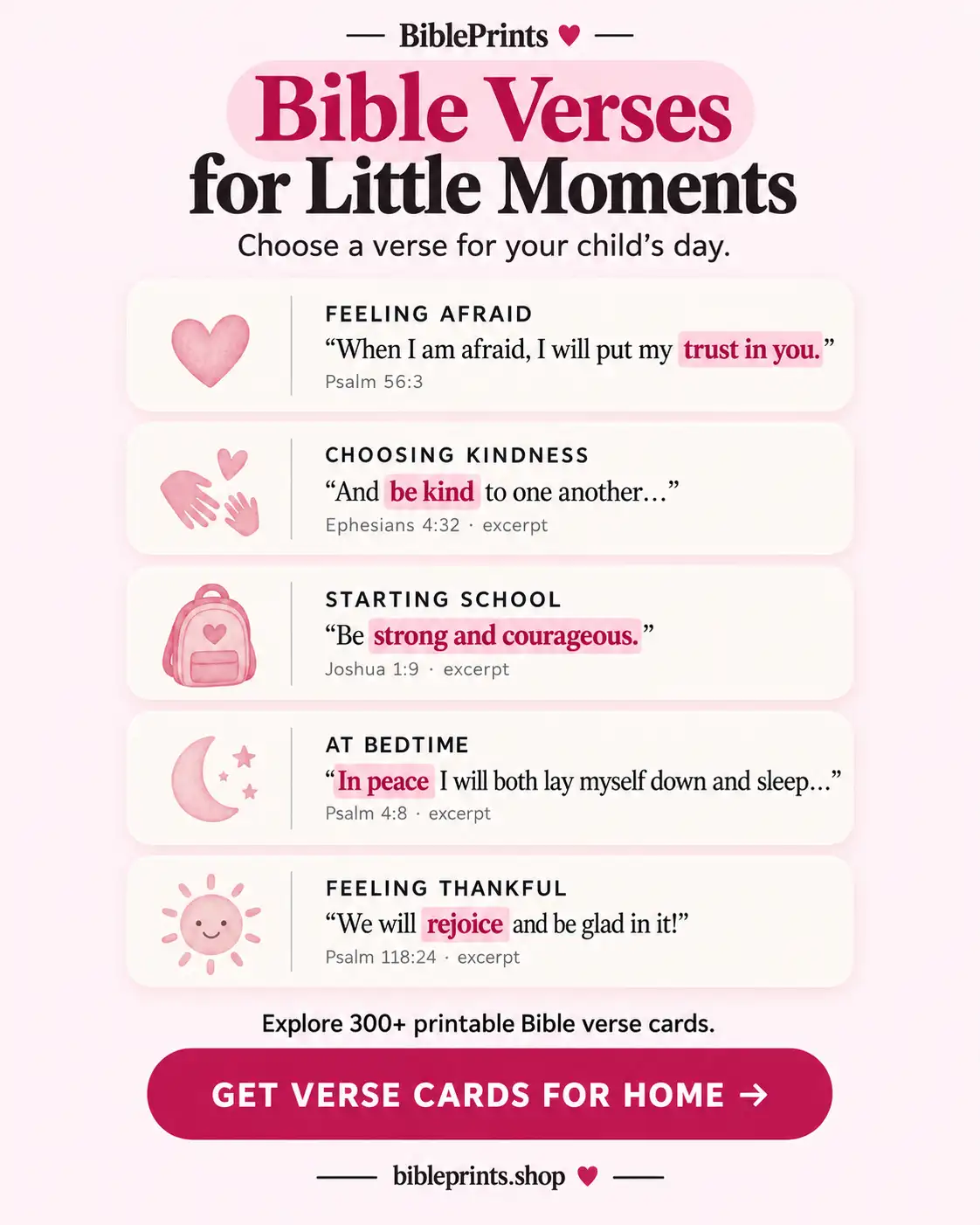
Kindergarten Scripture Chooser: Pick a Verse for the Moment
Parents often do not need “the most popular Bible verse for kids.” They need the right verse for what their child is facing today. Use this quick chooser before jumping into the full list.
A short response to fear: turn toward trust in God.
Connect kindness with forgiveness, not simply “being nice.”
Helps a child think about how they want to treat another person.
A memorable order: listen first, speak slowly, slow down anger.
Courage rooted in God's presence rather than guaranteed success.
Shows a child where worries can be taken: to God who cares.
A peaceful Scripture to read together before sleep.
Connect the beginning of a day with rejoicing and gratitude.
Use the familiar phrase “God is love,” then read the whole verse.
The picture of a lamp makes guidance easier for a young child to imagine.
10 Easy Bible Verses for Kindergarteners to Start With
If this is your child's first time memorizing Scripture, you do not need to begin with the longest or most famous passage. A good starter verse has a clear idea, connects naturally to a child's world, and gives you something meaningful to talk about after the words have been repeated.
| Verse | Simple Theme | Helpful Moment |
|---|---|---|
| Genesis 1:1 | God created | Nature, creation, first Bible memory verse |
| Psalm 56:3 | Trust God when afraid | First day of school, darkness, new places |
| Luke 6:31 | Treat others well | Friendship, sharing, fairness |
| Ephesians 4:32 | Kindness and forgiveness | Classmates, siblings, hurt feelings |
| 1 John 4:8 | God is love | Learning what God's character is like |
| Philippians 4:4 | Joy in the Lord | Morning routine, celebration, gratitude |
| 1 Thessalonians 5:16 | Rejoice | A very short first verse |
| 1 Thessalonians 5:17 | Prayer | Teaching that children can talk to God anytime |
| Psalm 118:24 | Thankfulness for today | Breakfast, morning devotion, school day |
| Numbers 6:24 | Blessing and care | Bedtime, lunchbox note, family blessing |
Looking specifically for even shorter passages? See our collection of short Bible verses.
How We Chose These Bible Verses for Ages 5–6
Shortness helps, but it is not our only filter. A three-word phrase a child cannot explain is not automatically more useful than a slightly longer verse that connects with something they experience every day.
This guide uses ages 5–6 as its practical kindergarten range, while recognizing that reading ability, attention, vocabulary, and Scripture familiarity vary from child to child. Choose by comprehension and usefulness, not by age label alone.
The child should have one main truth to hold onto rather than several abstract ideas at once.
Fear, friendship, kindness, bedtime, prayer, school, gratitude, and family are easier to discuss than vague concepts.
We favor verses that can be practiced in small chunks without pretending a shortened phrase is the entire verse.
Being able to explain a verse simply matters more than turning Scripture memory into a perfect-recitation contest.
When a popular verse is commonly stretched beyond its original setting, we point that out rather than teaching a misleading promise.
These are simple enough to begin young but meaningful enough to revisit as a child's understanding grows.
5 Bible Verses for Kids About God's Love and Character
These are strong foundational Scriptures for children who are beginning to ask simple but important questions such as “Who is God?”, “Did God make the world?”, and “Does God love us?”
Genesis 1:1 — God Created Everything
“In the beginning, God created the heavens and the earth.” Genesis 1:1 — World English Bible Classic (WEB)
Try this: Go outside and ask, “What can you see that reminds you of creation?” Then say the verse together.
Psalm 145:9 — God Is Good
“Yahweh is good to all. His tender mercies are over all his works.” Psalm 145:9 — World English Bible Classic (WEB)
Ask your child: “What is one good thing you can thank God for today?”
1 John 4:8 — God Is Love
“He who doesn’t love doesn’t know God, for God is love.” 1 John 4:8 — World English Bible Classic (WEB)
Hebrews 13:8 — Jesus Does Not Change
“Jesus Christ is the same yesterday, today, and forever.” Hebrews 13:8 — World English Bible Classic (WEB)
Try this: Name something that changed this year, then contrast it with the verse's statement about Jesus.
1 John 4:19 — Love Begins With God
“We love him, because he first loved us.” 1 John 4:19 — World English Bible Classic (WEB)
Parent prompt: “Who loved first in this verse?” Let your child answer before explaining.
5 Bible Verses for Kindergarteners About Kindness and Friendship
Kindergarten brings more time with classmates, teachers, siblings, teams, and group activities. These Scriptures give children simple language for listening, kindness, forgiveness, obedience, and being a light to others.
Luke 6:31 — Treat Others as You Want to Be Treated
“As you would like people to do to you, do exactly so to them.” Luke 6:31 — World English Bible Classic (WEB)
Ask: “If you were your friend, what would feel kind right now?”
Ephesians 4:32 — Be Kind and Forgiving
“And be kind to one another, tender hearted, forgiving each other, just as God also in Christ forgave you.” Ephesians 4:32 — World English Bible Classic (WEB)
Try this: Ask your child to name one kind action they could do before the day ends.
James 1:19 — Listen Before You React
“So, then, my beloved brothers, let every man be swift to hear, slow to speak, and slow to anger.” James 1:19 — World English Bible Classic (WEB)
Memory motion: Point to ears for “hear,” mouth for “speak,” then place hands down for “slow to anger.”
Colossians 3:20 — Obedience Can Please the Lord
“Children, obey your parents in all things, for this pleases the Lord.” Colossians 3:20 — World English Bible Classic (WEB)
Matthew 5:14 — Be a Light
“You are the light of the world. A city located on a hill can’t be hidden.” Matthew 5:14 — World English Bible Classic (WEB)
Ask: “What could being a light look like in your classroom today?”
5 Comforting Bible Verses for Kids About Fear, Courage, and School
A first school day, a dark room, a new teacher, a difficult task, or a friendship problem can feel enormous to a five-year-old. These verses do not promise that every hard situation disappears. They give a child truthful words to return to inside the hard moment.
Psalm 56:3 — A Bible Verse for Kids Who Feel Afraid
“When I am afraid, I will put my trust in you.” Psalm 56:3 — World English Bible Classic (WEB)
Lunchbox idea: Write the reference on a small note with, “If something feels scary today, remember where you can take that fear.”
Joshua 1:9 — Courage Comes With God's Presence
“Haven’t I commanded you? Be strong and courageous. Don’t be afraid. Don’t be dismayed, for Yahweh your God is with you wherever you go.” Joshua 1:9 — World English Bible Classic (WEB)
1 Peter 5:7 — Give Your Worries to God
“Casting all your worries on him, because he cares for you.” 1 Peter 5:7 — World English Bible Classic (WEB)
Try this: Let your child name one worry, pray about that exact worry, then repeat the verse together.
Psalm 4:8 — A Peaceful Bedtime Verse
“In peace I will both lay myself down and sleep, for you alone, Yahweh, make me live in safety.” Psalm 4:8 — World English Bible Classic (WEB)
Bedtime practice: Say the verse slowly once, then let your child tell God one thing they are thankful for before sleep.
Psalm 23:1 — God as Shepherd
“Yahweh is my shepherd; I shall lack nothing.” Psalm 23:1 — World English Bible Classic (WEB)
Ask: “What does a good shepherd do for sheep?” Use their answers to begin explaining the Psalm.
For additional passages about courage and assurance, see our Bible verses about confidence and encouraging Bible verses.
5 Short Bible Verses for Kids About Joy, Prayer, and Gratitude
These verses fit naturally into routines children already understand: waking up, eating together, praying, celebrating, and noticing good things during the day.
Philippians 4:4 — Rejoice in the Lord
“Rejoice in the Lord always! Again I will say, ‘Rejoice!’” Philippians 4:4 — World English Bible Classic (WEB)
Try this: Say “Rejoice!” together with a simple hand motion to make the repeated word memorable.
1 Thessalonians 5:16 — One of the Shortest Joy Verses
“Always rejoice.” 1 Thessalonians 5:16 — World English Bible Classic (WEB)
1 Thessalonians 5:17 — Pray Throughout Life
“Pray without ceasing.” 1 Thessalonians 5:17 — World English Bible Classic (WEB)
Ask: “Where are three places you can pray?” Let your child discover that prayer is not tied to one location.
Psalm 107:1 — Give Thanks Because God Is Good
“Give thanks to Yahweh, for he is good, for his loving kindness endures forever.” Psalm 107:1 — World English Bible Classic (WEB)
Try this: Have everyone at the table name one thing they can thank God for before repeating the verse.
Psalm 118:24 — A Bible Verse for the Start of the Day
“This is the day that Yahweh has made. We will rejoice and be glad in it!” Psalm 118:24 — World English Bible Classic (WEB)
Morning prompt: “What is one good way we can use this day?”
5 Easy Scriptures for Kids About Guidance and Growing Faith
These verses help move Scripture memory beyond behavior rules. They teach children where trust, guidance, compassion, blessing, and praise fit in a growing life of faith.
Proverbs 3:5 — Trust God With Your Whole Heart
“Trust in Yahweh with all your heart, and don’t lean on your own understanding.” Proverbs 3:5 — World English Bible Classic (WEB)
Psalm 119:105 — God's Word Gives Guidance
“Your word is a lamp to my feet, and a light for my path.” Psalm 119:105 — World English Bible Classic (WEB)
Visual idea: Turn off a room light briefly and use a flashlight to show why “lamp” and “path” are memorable pictures.
John 11:35 — Jesus Wept
“Jesus wept.” John 11:35 — World English Bible Classic (WEB)
Numbers 6:24 — A Short Bible Blessing for Children
“Yahweh bless you, and keep you.” Numbers 6:24 — World English Bible Classic (WEB)
Try this: Say the verse over your child rather than only asking them to perform it from memory.
Psalm 150:6 — Let Everything Praise the Lord
“Let everything that has breath praise Yah! Praise Yah!” Psalm 150:6 — World English Bible Classic (WEB)
Make it active: Clap a simple rhythm while saying the verse, then let your child choose a movement for the repeated word “praise.”
A Better Way to Help a 5-Year-Old Memorize Bible Verses
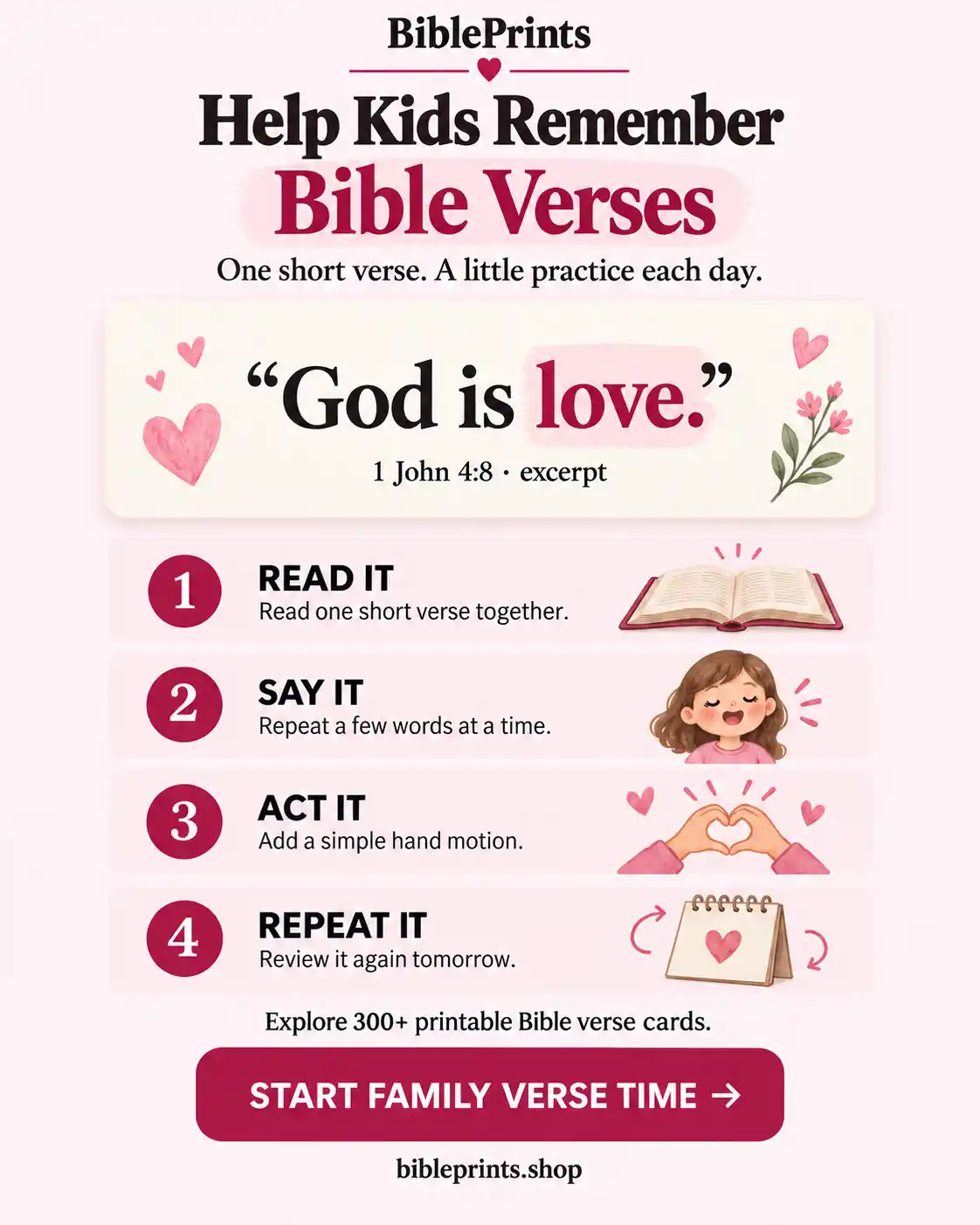
Scripture memory should not become a race to collect references. A useful rhythm combines seeing the words, saying them, understanding one idea, connecting that idea to life, and reviewing it later.
Use this simple SEE → SAY → EXPLAIN → USE → REVIEW framework with one verse before adding another.
A Low-Pressure One-Week Scripture Rhythm
4 Low-Pressure Bible Memory Activities for Kindergarteners
Read one short phrase and let your child echo it back. Add the next phrase only when the first feels familiar.
Repeat a familiar verse but pause before one easy word. Let your child fill in the blank without turning it into a test.
Choose one simple hand motion for a key word such as trust, listen, pray, light, or rejoice, then repeat the verse with the motion.
Keep the verse card visible in one familiar place. Ask your child to find it, read or hear it again, and explain one idea in their own words.
Should Kindergarteners Memorize the Whole Verse or a Short Phrase?
There does not need to be a false choice between “only tiny phrases” and “force a five-year-old to master every long sentence immediately.”
For example, “God is love” is an excellent phrase for a young child to remember, but it comes from the fuller sentence in 1 John 4:8. A parent can begin with that phrase, then gradually help the child hear and understand the whole verse.
This also gives children an important habit early: a memory card or short quotation points us back to the Bible; it does not replace the surrounding passage.
How Parents and Teachers Can Use Kids Bible Verses in Everyday Life
Keep one verse visible for the week and read it once before the school rush begins.
Repeat a familiar verse rather than introducing a brand-new passage while everyone is distracted.
Pair a verse reference with one short personal note such as “Remember where to take your fear today.”
Use one verse for handwriting, reading, discussion, and memory rather than treating each activity as unrelated work.
Explain the verse before asking for recitation, then use a motion, picture, or question to reinforce the meaning.
Choose comfort, prayer, or blessing verses rather than turning bedtime into a test the child must pass.
If your child is having an especially difficult or emotionally heavy day, our guide to Bible verses for feeling overwhelmed offers additional passages for adults and families to explore together.
5 Common Mistakes When Teaching Bible Verses to Kids
- Choosing only by word count. “Jesus wept” is easy to recite, but a meaningful verse also needs context and a truth your child can begin to understand.
- Changing the verse but keeping quotation marks around it. Kid-friendly explanation is useful. Rewritten Scripture presented as an exact Bible quotation is confusing. Label explanations as explanations.
- Rewarding perfect performance while ignoring meaning. A child who misses one word but can tell you what a passage means may be engaging more deeply than a child who can repeat it without understanding.
- Turning every verse into a promise of immediate success. Joshua 1:9 is not a guarantee that a test, game, or school day will go exactly as hoped. Keep application connected to the passage's actual message.
- Trying to memorize too many verses at once. One Scripture that becomes familiar, understood, and reusable can be more valuable than a stack of verses rushed through and forgotten.
Frequently Asked Questions About Bible Verses for Kindergarteners
Which Bible verse is best for kindergarteners?
There is no single best verse for every child or situation. Genesis 1:1 is an excellent first verse about creation; Psalm 56:3 works well for fear; Luke 6:31 for treating others; Ephesians 4:32 for kindness and forgiveness; and Philippians 4:4 for joy. Match the verse to what the child is learning or experiencing.
What is an easy Bible verse for a 5-year-old?
1 Thessalonians 5:16, “Always rejoice,” is exceptionally short. Psalm 56:3 and Genesis 1:1 are also manageable because they center on one concrete idea. Easy should mean more than short: choose a verse your child can begin to explain as well as repeat.
What are some short Bible verses for kids to memorize?
Good starting references include 1 Thessalonians 5:16–17, Genesis 1:1, Psalm 56:3, 1 John 4:8, Philippians 4:4, Numbers 6:24, Luke 6:31, and Psalm 118:24. Read the exact verse in your chosen translation before practicing shortened key phrases.
Can a 5-year-old memorize Scripture before reading independently?
Yes. Independent reading is not required for a child to hear, repeat, discuss, sing, or recall a Bible verse. A parent or teacher can read the text aloud while the child learns through repetition, conversation, movement, and familiar routines.
How many Bible verses should a kindergartener learn at once?
Start with one. Keep it long enough for the child to recognize the words, explain the main idea, and recall it later. There is no need to move to a new verse simply because a calendar says the week is over.
Should children memorize the full Bible verse or only a short phrase?
Use the full verse when it is manageable. For longer verses, practicing in chunks or beginning with a clearly labeled key phrase can make learning easier. The important part is not to present a paraphrase or excerpt as though it were the complete Bible verse.
What Bible verse can help a child who is scared at school?
Psalm 56:3 is a strong choice: “When I am afraid, I will put my trust in you.” It acknowledges that fear can be real while teaching a simple response of trust. Joshua 1:9 can also introduce courage grounded in God's presence.
Can Bible verse cards help children memorize Scripture?
Cards can make one verse easier to keep visible and revisit during an existing routine. The card itself is not the goal; use it as a prompt to read the verse, say it aloud, explain its meaning, apply it to a real situation, and return to the surrounding Bible passage.
What is a good Bible verse for a 6-year-old?
Psalm 56:3, Luke 6:31, Ephesians 4:32, Genesis 1:1, and Psalm 118:24 are all useful choices for many six-year-olds because each centers on a clear idea that can connect to school, friendship, fear, creation, or gratitude. Start with one verse and adjust the pace to the child rather than assuming every six-year-old learns the same way.
Can preschoolers use these kindergarten Bible verses too?
Some can. Very short passages or clearly labeled key phrases may work well for younger children, especially with repetition, songs, pictures, or motions. This guide is organized for ages 5–6, so for a younger child choose the simplest entries and focus on understanding one idea rather than completing the whole list.
Which Bible translation is used in this guide?
Exact Scripture quotations in this BiblePrints guide use the World English Bible Classic (WEB), the public-domain edition that uses “Yahweh” in the Old Testament. Kid-friendly meanings and parent prompts are original explanations and are deliberately separated from the quoted Bible text.
About This BiblePrints Scripture Guide
BiblePrints created this guide for parents, grandparents, homeschool families, and children’s ministry teachers who want age-appropriate starting points for Scripture memory. The 25 passages were organized by clarity, everyday usefulness, manageable wording, teachable context, and the kinds of real situations a kindergarten-age child may encounter.
Exact quotations are identified as World English Bible Classic (WEB). BiblePrints writes the simple meanings, parent prompts, decision aids, and applications in original wording, and separates those explanations from the quoted Bible text. Readers are encouraged to return to the surrounding passage so a short memory verse stays connected to its biblical context.
Learn more about our approach on the BiblePrints About page.