
How to Read the Bible: A Beginner’s Guide to Starting, Understanding & Staying Consistent
If you want to read the Bible but feel unsure about where to start, what order to follow, which translation to choose, or how to understand what you are reading, this guide gives you a practical path without turning Bible reading into a checklist.
Quick Answer: How Should a Beginner Read the Bible?
Start small, begin with a book that matches your goal, read whole passages in context, and build a repeatable daily habit. If you mainly want to meet Jesus, start with Mark or John. If you want the Bible’s big story from the beginning, start with Genesis. Read for about 10–15 focused minutes, ask what the passage meant in its own context before asking how it applies to you, and do not worry about understanding everything on the first pass.
There is no single Bible verse that commands every reader to use one universal reading order. A good first plan is one you can understand, continue, and return to.
Read It Today. Keep It in Front of You Tomorrow.
Closing your Bible should not mean forgetting the verse that mattered five minutes later. BiblePrints printable Scripture cards give Bible readers a simple way to keep meaningful passages visible after reading—beside a Bible, inside a journal, at a desk, or in a prayer space.
- ✓ 300+ printable Scripture cards
- ✓ Made for revisiting & memorizing verses
- ✓ A4 + US Letter · instant digital access
Where Should You Start Reading the Bible?
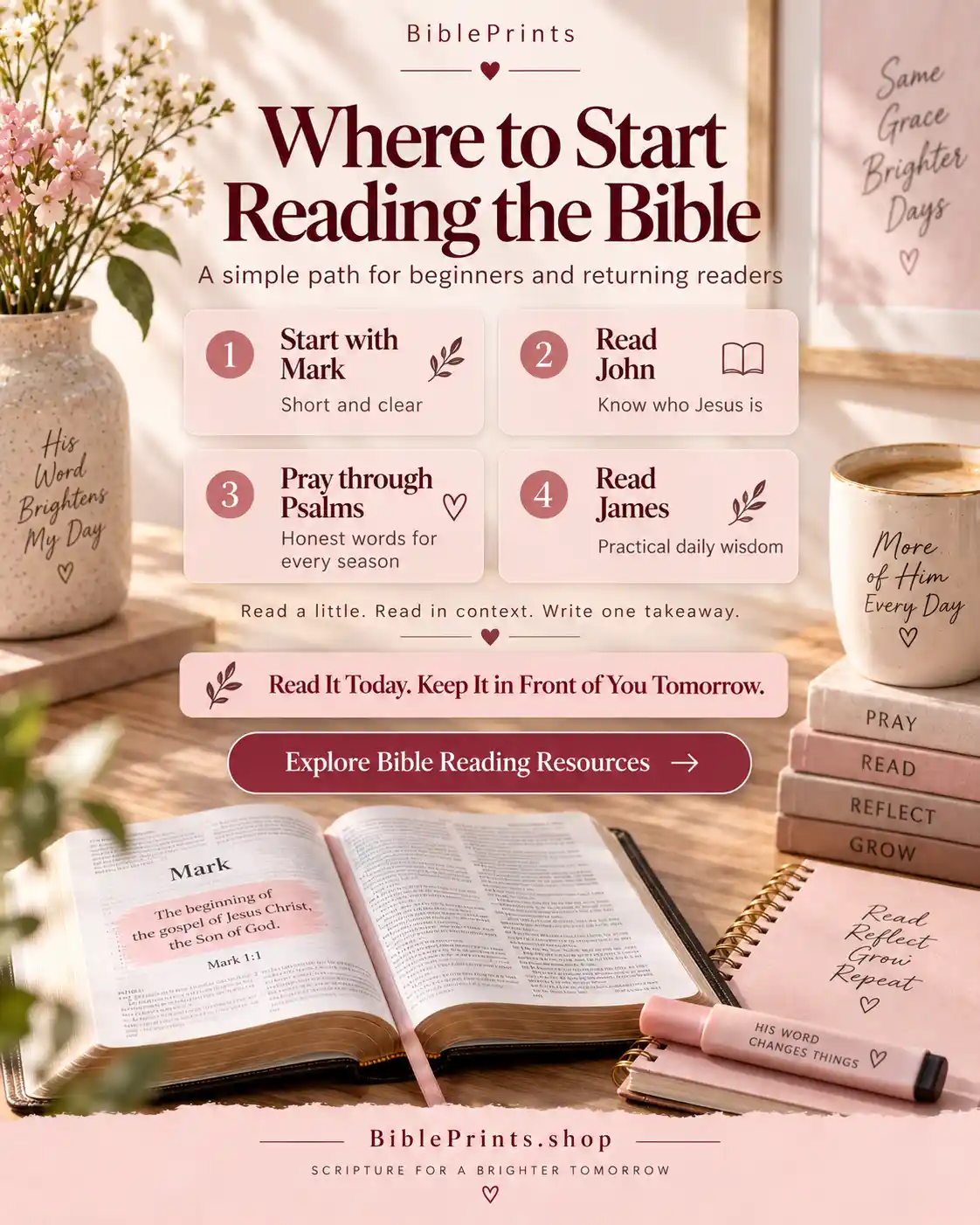
The best starting book depends on what you are trying to understand first. That is more useful than pretending one reading order is perfect for every beginner. In real beginner discussions, the same tensions appear repeatedly: some readers want Jesus first, some want the story from Genesis, some prefer chronology, and others simply need a shorter book so they can build momentum.
| Your goal | Start with | Why it works | What to read next |
|---|---|---|---|
| Meet Jesus quickly | Mark | Short, fast-moving Gospel centered on Jesus’ ministry, death, and resurrection. | John → Acts → James |
| Understand who Jesus is more deeply | John | Focuses strongly on Jesus’ identity, signs, teaching, and the meaning of belief. | Mark or Luke → Acts → Romans |
| Understand the Bible’s beginning and big story | Genesis | Introduces creation, human rebellion, covenant, Abraham, and the family of Israel. | Exodus → a Gospel → Acts |
| Learn to pray through real emotions | Psalms | Gives language for praise, grief, fear, confession, hope, and worship. | Mark or John → selected Psalms alongside it |
| Get practical wisdom for daily life | Proverbs or James | Both contain concise, practical instruction, though they belong to different genres and contexts. | A Gospel → Acts |
| Read the whole Bible as a connected story | Use a reading plan | A canonical or chronological plan helps you keep track of progress and larger connections. | Stay with the plan, but slow down when context needs attention. |
How to Start Reading the Bible Without Getting Overwhelmed
You do not need a perfect plan, a theology library, or hours of free time to begin. You need a readable Bible, a clear starting point, a small amount of focused time, and a way to keep going when the first burst of motivation fades.
Pick one book before you pick a massive plan
A beginner often does better finishing one understandable book than repeatedly restarting a year-long plan. Mark has 16 chapters, so it gives you a reachable first finish line. John is longer but excellent if your main question is who Jesus is and why he matters.
Use a small daily target
Start with one chapter or about 10–15 minutes. Some days you may read more; other days a paragraph may be enough because it raises questions worth thinking about. The goal is not to win a page-count contest. The goal is to understand the text well enough to keep moving through the book.
Read the passage before you reach for commentary
Give the biblical text your first attention. After you have read it, use a book introduction, study Bible, map, cross-reference, or trusted teacher to answer questions. Tools are most useful when they help you see the text more clearly rather than replacing the text.
Write one sentence and one question
After each session, finish this sentence: “The main thing I saw in this passage was…” Then write one question you still have. That small habit forces you to process what you read without turning every session into a research project.
Come back to the same book tomorrow
Random verses can encourage you, but continuous reading helps you learn a biblical author’s argument and story. Keep your bookmark in the same book until you finish it, even if you also read a Psalm or Proverb on the side.
Which Bible Translation Should a Beginner Read?
Choose a translation you can understand well enough to keep reading. English Bible translations differ because translators make different choices about how closely to preserve ancient wording and how naturally to express the meaning in modern English. No short label captures every translation decision, but the table below gives beginners a practical starting point.
| If you want... | Common options | Useful approach |
|---|---|---|
| Very readable contemporary English | NLT | Helpful for a smooth first read; compare a more formal translation for close study. |
| Readable, widely used middle ground | NIV, CSB | Good main-reading choices for many beginners. |
| More formal wording for close observation | ESV, NRSVue, NASB | Useful when you want to see wording and structure more closely. |
| Traditional English style | KJV | Historically influential, but older vocabulary and grammar can make a first read harder. |
If you are Catholic or Orthodox, choose an edition that contains the books used in your tradition. Protestant, Catholic, and Orthodox Bibles do not all contain the exact same table of contents. If a verse seems unusually difficult, compare two or three reputable translations before assuming the first wording you saw settles every interpretive question.
How to Read the Bible in Order: Canonical, Chronological & Beginner Paths
If you are wondering how to read the Bible in order, there are three main approaches: the standard canonical order printed in your Bible, a chronological order that rearranges events by timeline, or a beginner-focused path that starts with Jesus and then builds the larger biblical story. There is no universally required personal reading order. The Bible’s books form a canon, not a modern novel in which every next book is automatically the next event in time. Different Christian traditions also arrange or include some books differently, so the best route depends on whether your goal is orientation, history, spiritual formation, literary understanding, or reading the entire canon.
Quick Answer: What Order Should You Read the Bible In?
For most first-time Christian readers, a practical path is Mark or John → Acts → James or Ephesians → Genesis → Exodus → selected Psalms and Proverbs → the rest of the New Testament → the rest of the Old Testament. If your goal is historical sequence instead, use a chronological plan. If your goal is to experience the Bible exactly as printed, read Genesis through Revelation in canonical order.
| Route | Good for | Suggested approach | Main caution |
|---|---|---|---|
| Jesus-first | New Christians and readers unfamiliar with Jesus | Mark or John → Luke → Acts → selected letters → Genesis | You meet the New Testament before seeing every Old Testament foundation. |
| Story-first | Readers who learn through narrative and history | Genesis → Exodus → major narrative books → Gospels → Acts | Law, genealogies, and repeated history can slow first-time readers. |
| Canonical | Readers determined to experience their Bible in printed order | Genesis → Revelation, book by book | Do not assume every neighboring book is the next event chronologically. |
| Chronological | Readers who want events placed on a timeline | Follow a reputable chronological plan | Some dates and placements are debated; chronology is reconstructed. |
| Book + prayer/wisdom | Readers who want variety without losing context | Read one main book continuously while adding one Psalm or Proverb | Keep the main book as your anchor so your reading does not become random. |
Should a beginner read the Bible from Genesis to Revelation?
You can, and many readers eventually benefit from experiencing the Bible in canonical order. But it is not the only responsible first route. A recurring beginner problem is reaching dense legal or genealogical material before understanding the larger story and losing momentum. If that has happened to you, changing your route is not failure.
Should you read the Bible in chronological order?
A chronological plan can be excellent for seeing how kings, prophets, wars, exile, and return relate to one another. It is especially useful once you already know the broad storyline. It is also more complicated than it looks because several biblical books overlap and the dating of some texts or events is debated. Treat chronological order as a study framework rather than a claim that every placement is undisputed.
How to Read and Understand the Bible Without Losing the Context
Learning how to read and understand the Bible starts with context, not with finding an instant personal meaning in every verse. Before asking, “What does this verse mean to me?”, ask what the author was communicating in that passage, to those readers, in that part of the book. Then identify the genre, summarize the main point, compare difficult wording when needed, and only after that ask how the passage applies today. Personal application becomes stronger when it grows from the text’s meaning rather than replacing it.
Quick Answer: How Do You Read the Bible and Understand It?
Read one complete passage, identify who wrote it and to whom, notice the literary genre, summarize the author’s main point in your own words, and then ask how that truth applies. When a passage is difficult, compare reputable translations and use a study Bible, book introduction, map, or trusted commentary after you have first read the text for yourself.
1. Read a complete unit
Read the paragraph, scene, poem, or argument around the verse. Single verses are easy to detach from the point their author was making.
2. Ask basic context questions
Who is speaking or writing? To whom? What problem or situation is being addressed? What happened immediately before and after?
3. Identify the genre
A proverb, a law, a poem, a historical narrative, a letter, and an apocalyptic vision do not communicate in exactly the same way.
4. Summarize the main point
If you cannot explain the passage in one or two plain sentences, slow down before trying to build a life lesson from it.
5. Ask what it reveals
What does the passage show about God, people, faithfulness, sin, wisdom, hope, or the unfolding biblical story?
6. Respond carefully
After understanding the passage, ask whether there is something to believe, obey, avoid, pray, remember, or investigate further.
A simple three-question method
- What does the passage say? Observe the words, structure, people, actions, repeated ideas, and contrasts.
- What does it mean in context? Consider author, audience, genre, surrounding passage, and place in the book.
- How should I respond? Only after the first two questions, consider belief, action, prayer, repentance, encouragement, or a question to study further.
A context example: Philippians 4:13
Philippians 4:13 is often used as a general promise that a Christian can accomplish any chosen goal. But Philippians 4:10–13 is about Paul learning contentment through changing circumstances—having much and having little. Reading the surrounding paragraph does not make the verse less encouraging; it makes the encouragement more precise.
This is also why topical verse collections should be treated as doorways, not substitutes for reading the full passage. If you use a list such as encouraging Bible verses, open the verses that stand out and read their surrounding paragraphs or chapters.
The Bible Is a Library: Read Each Genre on Its Own Terms
One of the fastest ways to become a better Bible reader is to stop reading every page the same way. The Bible contains narrative, poetry, wisdom, law, prophecy, Gospel, letters, and apocalyptic literature. BibleProject’s How to Read the Bible series is a useful visual introduction to these literary differences.
| Genre | What to watch for | Common beginner mistake |
|---|---|---|
| Narrative / history | Plot, conflict, repeated themes, narrator comments, consequences | Assuming every action a character takes is an example to copy |
| Poetry / Psalms | Imagery, parallel lines, emotion, prayer, praise, lament | Flattening poetic images into wooden literal statements |
| Wisdom / Proverbs | Patterns of wise living and observations about life | Treating every proverb as an unconditional promise with no exceptions |
| Biblical law | Ancient Israel’s covenant setting and its place in the larger story | Reading a law without asking who received it and under what covenant setting |
| Prophets | Original historical crisis, covenant language, poetry, warning, hope | Jumping directly from ancient imagery to today’s headlines |
| Gospels | Whole episodes, each Gospel writer’s themes, Jesus’ words and actions | Combining details too quickly and missing what each Gospel emphasizes |
| New Testament letters | Author, recipients, problem being addressed, argument flow | Reading a sentence without the paragraph or letter around it |
| Apocalyptic literature | Symbols, Old Testament echoes, visions, hope, judgment, faithfulness | Treating every symbol as a one-to-one prediction of a current event |
Bible Reading and Bible Study Are Related, but They Are Not the Same
Reading gives you breadth; study gives you depth. Beginners often burn out because they try to perform a word study on every sentence before they have even learned the shape of the book. A healthier approach is to read first and study selected passages second.
Use a two-pass approach
- Pass one — read for flow: Read the whole paragraph or chapter without stopping every few words. Notice the main idea, people, movement, and repeated words.
- Pass two — slow down: Return to the section that raised the biggest question. Compare translations, check cross-references, use a study Bible or commentary, and write what you learned.
What is the SOAP method for Bible reading?
SOAP is a simple journaling method: Scripture, Observation, Application, Prayer. It can be useful after you have read a passage in context. Write the reference or a short portion you are studying, note what you observe in the text, identify a responsible application, and turn that response into prayer.
SOAP is a tool, not a rule. If the “Application” step tempts you to force every passage into a personal life hack, pause and ask what the passage meant first.
How to Start Reading the Bible Daily and Stay Consistent
Make the habit small enough to repeat and meaningful enough to return to. A five- or ten-minute minimum is often better for a new reader than an ambitious plan that collapses after three days.
Use the same cue
Attach reading to something that already happens: after coffee, at lunch, before bed, or immediately after you sit at your desk.
Reduce friction
Leave your Bible, notebook, bookmark, and pen ready. If you read digitally, open the book you are reading instead of deciding from scratch every day.
Protect attention
If your phone is the Bible, turn on Do Not Disturb. If notifications pull you away, use a physical Bible for the reading itself.
Track continuity, not perfection
If you miss a day, continue where you stopped. Do not punish yourself with double readings or restart the entire plan unless you genuinely want to.
If a short passage is all you can manage on a difficult day, use it as a doorway back into Scripture. Read one paragraph carefully, carry one verse with you, and return to the book the next day instead of abandoning the habit.
One Verse Today. Come Back Tomorrow.
Read one passage → keep one verse → return tomorrow.
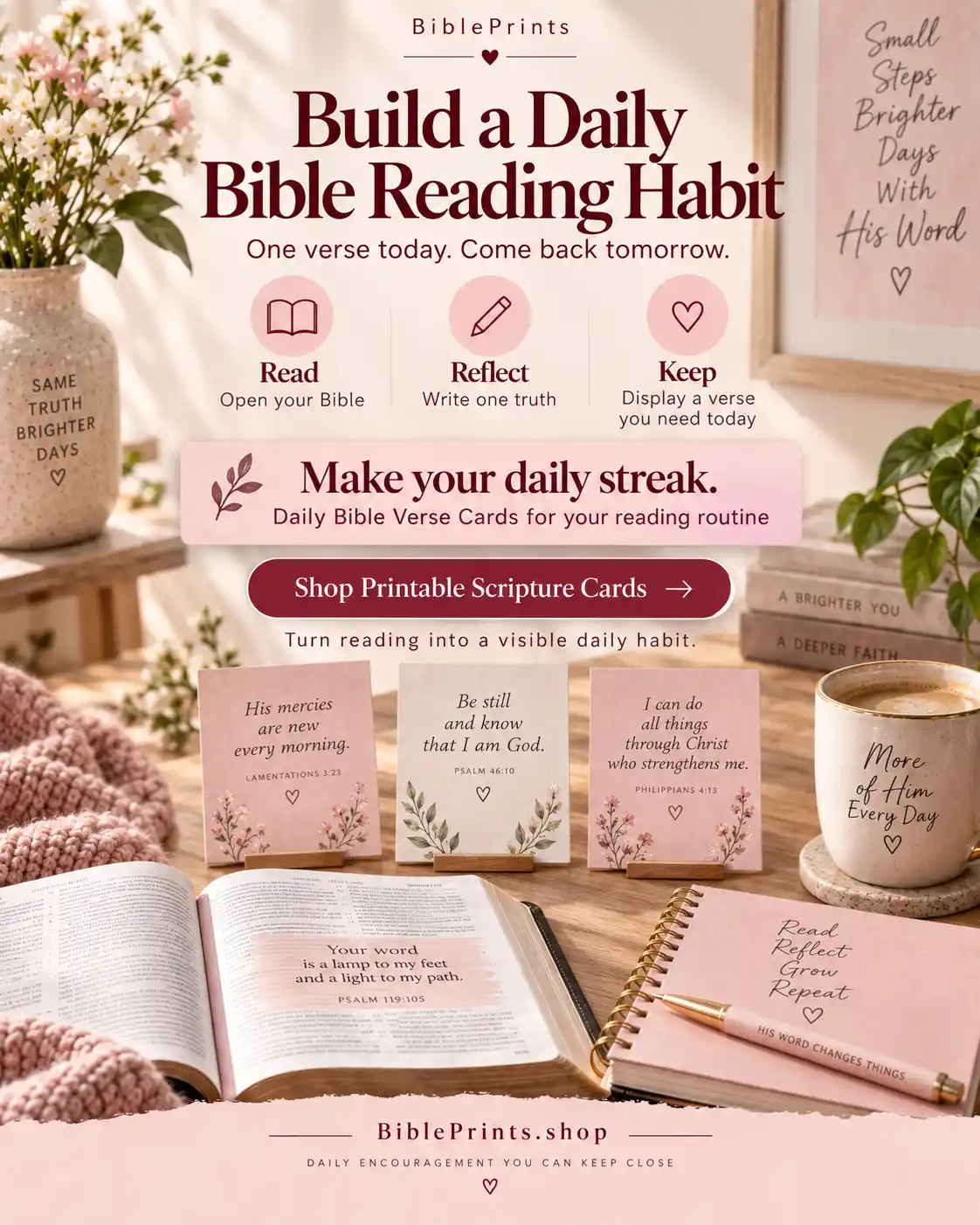
A daily Bible-reading streak becomes useful when it helps you return to Scripture, not when the number becomes the goal. Start small enough to repeat, keep the verse you read visible, and let consistency build the habit.
Start My Daily Scripture Habit →For memorization or quick review, keep a few short Bible verses nearby, but continue reading full books so your understanding grows beyond isolated lines. Printable Bible Scripture cards can also help you revisit passages you have already read in context.
A 30-Day Bible Reading Roadmap for Beginners
This is an orientation plan, not the only correct plan. It deliberately gives you one complete Gospel, a short practical letter, the opening of Genesis, and the beginning of Acts so you encounter several major parts of the Bible without bouncing randomly from verse to verse.
| Days | Read | What to notice |
|---|---|---|
| 1–16 | Mark 1–16 | Jesus’ identity, teaching, authority, conflict, death, and resurrection. Read one chapter a day. |
| 17–21 | James 1–5 | Trials, wisdom, speech, favoritism, faith and works, prayer, practical Christian living. |
| 22–24 | Genesis 1–3 | Creation, human vocation, temptation, rebellion, judgment, and the problem the rest of the biblical story addresses. |
| 25–30 | Acts 1–6 | The risen Jesus’ followers, the Holy Spirit, witness, the early church, growth, conflict, and service. |
At the end of 30 days, choose your next route: finish Acts, read John, continue Genesis, or begin a longer whole-Bible plan. The important thing is that your second month grows naturally from what you actually completed in your first.
A Simple Prayer Before Reading the Bible
Prayer before reading does not need to be long or polished. For a Christian reader, the purpose is to approach Scripture with humility, attention, and a willingness to respond. If you are reading the Bible for historical or literary understanding and prayer is not part of your purpose, you can still pause and set a clear intention to read carefully and fairly.
What to Do When the Bible Feels Confusing, Difficult, or Boring
Do not assume confusion means you are failing. Some biblical books are genuinely harder for modern readers because they come from ancient cultures, use unfamiliar literary forms, contain long genealogies or laws, or assume background knowledge you do not yet have.
- Mark the question and keep reading. Sometimes the next paragraph answers what confused you.
- Read the whole chapter. A confusing sentence may make sense when you see the argument or story around it.
- Check the book introduction. Knowing the author, audience, setting, and genre often removes much of the confusion.
- Compare one or two translations. A different wording can make an unclear sentence easier to follow without turning your reading into a translation debate.
- Use maps and timelines for history. Geography and sequence matter in books such as Joshua, Samuel, Kings, Ezra, Nehemiah, and Acts.
- Ask a mature reader. A pastor, priest, teacher, small group leader, or knowledgeable Christian friend can help you see interpretive questions you may miss alone.
- Return later. You do not have to solve every hard passage on your first encounter.
If Bible reading itself is making you feel mentally overloaded, it is okay to simplify the session. BiblePrints also has a Scripture guide for moments when you are feeling overwhelmed; use topical encouragement as support while keeping your long-form Bible reading rooted in context.
How Long Does It Take to Read the Bible?
Raw reading time and meaningful reading time are different questions. A commonly cited estimate for reading the whole Bible straight through is roughly 70–80 hours, but the real number changes with translation, reading speed, pauses, note-taking, and whether you reread difficult sections. International Christian College and Seminary notes that published estimates vary and emphasizes that reflective reading takes longer than simply finishing the words.
A one-year plan often works out to roughly 10–20 minutes a day for many readers, but you do not need to finish the Bible in a year to be a serious reader. If you are new, finishing one Gospel carefully may teach you more about how to read Scripture than racing through hundreds of chapters you barely remember.
Further reading: How Long Does It Take To Read The Whole Bible? — ICCS
Common Beginner Bible-Reading Mistakes
1. Treating the Bible like one modern novel
The Bible is a collection of books written in different genres and historical settings. A letter to a first-century church should not be read exactly like Proverbs, Genesis, Psalms, or Revelation.
2. Reading only isolated verses
Verse numbers are useful navigation tools, but they were not part of the original manuscripts. Read the paragraph and book around the verse.
3. Trying to understand everything before moving on
Your first reading builds a map. Later readings fill in roads, neighborhoods, and details. Keep a question list rather than letting one difficult verse stop an entire book.
4. Choosing a plan because it sounds impressive
A 90-day whole-Bible plan can be excellent for an experienced reader with time. It can also be a poor first plan for someone who has never finished a Gospel. Match the plan to your current capacity.
5. Applying before interpreting
Ask what the passage meant in context before asking how it applies today. Application without interpretation can turn Scripture into a mirror for ideas you already had.
6. Assuming a missed day ruined the habit
You do not need to “start over.” Open the bookmark and continue. A sustainable reading life is built over years, not proven by an unbroken perfect streak.
7. Letting tools replace Scripture
Study Bibles, videos, podcasts, commentaries, devotionals, and AI tools can help, but they should send you back to the text rather than become the only thing you read.
Frequently Asked Questions About Starting Bible Reading
Where should a beginner start reading the Bible?
Start with Mark if you want a short, direct introduction to Jesus, or John if you want a deeper focus on who Jesus is. Start with Genesis if your main goal is understanding the Bible’s beginnings and larger storyline.
How do I start reading the Bible daily?
Choose one book, one consistent time, and a small minimum such as one chapter or 10 minutes. Keep your Bible ready, remove distractions, and continue from your bookmark instead of choosing a new passage every day.
Which Bible translation is easiest for a beginner?
Choose a modern translation you can read comfortably and compare another translation when wording is difficult. Common beginner-friendly options include the NLT, NIV, CSB, ESV, and NRSVue; readers should also choose an edition that matches the canon used in their Christian tradition.
Should I read Psalms or Proverbs first?
Choose Psalms if you want prayer, worship, lament, and emotional honesty; choose Proverbs if you want compact wisdom for daily choices. You can also read one of them alongside a Gospel without replacing your main book.
Can I listen to the Bible instead of reading it?
Yes. Audio Bible listening can be a legitimate way to take in Scripture, especially for narrative books or when reading is difficult. For close study, pause, replay, or pair the audio with the written text so you can examine context and wording.
Can I study the Bible by myself?
Yes, personal study is valuable, but you do not have to study in isolation. Book introductions, cross-references, mature Christian teachers, pastors or priests, and a healthy church community can help when passages are difficult or traditions interpret them differently.
About This BiblePrints Bible-Reading Guide
Who created this guide: BiblePrints, a Christian Scripture and printable Bible resource website. No pastoral, theological, or academic credential is being claimed here; the goal is transparent, careful editorial guidance for everyday Bible readers.
How this guide was prepared: BiblePrints compared recurring beginner questions, current search-result patterns, reader discussions, Bible-reading resources, and common points of confusion. The article then turns that research into an original goal-based framework instead of copying a competitor’s order or presenting one tradition’s preferred sequence as universally required.
Why this guide exists: A beginner should leave knowing what to open first, how much to read, how to keep context in view, what to do when a passage is difficult, and how to return tomorrow. The page is designed to solve that reader problem first; search visibility is secondary.
Scripture & translation note: When BiblePrints uses longer exact Bible quotations, it favors the public-domain World English Bible (WEB) from eBible.org and identifies the translation. Explanations in this guide are written in original wording, and readers are encouraged to read cited passages in their full surrounding context.
Tradition note: Protestant, Catholic, and Orthodox Christians do not all use identical biblical canons or interpret every passage in the same way. This guide distinguishes practical reading advice from biblical claims and avoids presenting one optional reading plan as the only faithful approach.
Your Next Step Is Smaller Than You Think
You do not need to master the Bible before you can begin reading it well. Pick one book, read the next passage, keep the context in view, write down one thing you learned, and come back tomorrow. Over time, the books, people, themes, and connections that once felt unfamiliar begin to form a map.
Start with the next chapter—not the perfect plan.
Pingback: bible journling -
Pingback: soap bible study -