
Women of the Bible: 40 Important Women, Their Stories & Lessons
Meet the women of Scripture as real people in real stories—not as one-line inspirational labels. This guide gives you a fast reference list, deeper context for the best-known women, lesser-known names worth studying, and practical lessons on faith, courage, grief, leadership, wisdom, and everyday discipleship.
Quick Answer
The most significant women of the Bible include Eve, Sarah, Hagar, Rebekah, Miriam, Rahab, Deborah, Ruth, Hannah, Abigail, Esther, Mary the mother of Jesus, Mary Magdalene, Martha, Lydia, Priscilla, and Phoebe. Their stories span creation, covenant, exile, leadership, prophecy, discipleship, hospitality, grief, courage, and the growth of the early church. There is no single biblical “top 12”; the best woman to study depends on the question or season you are bringing to Scripture.
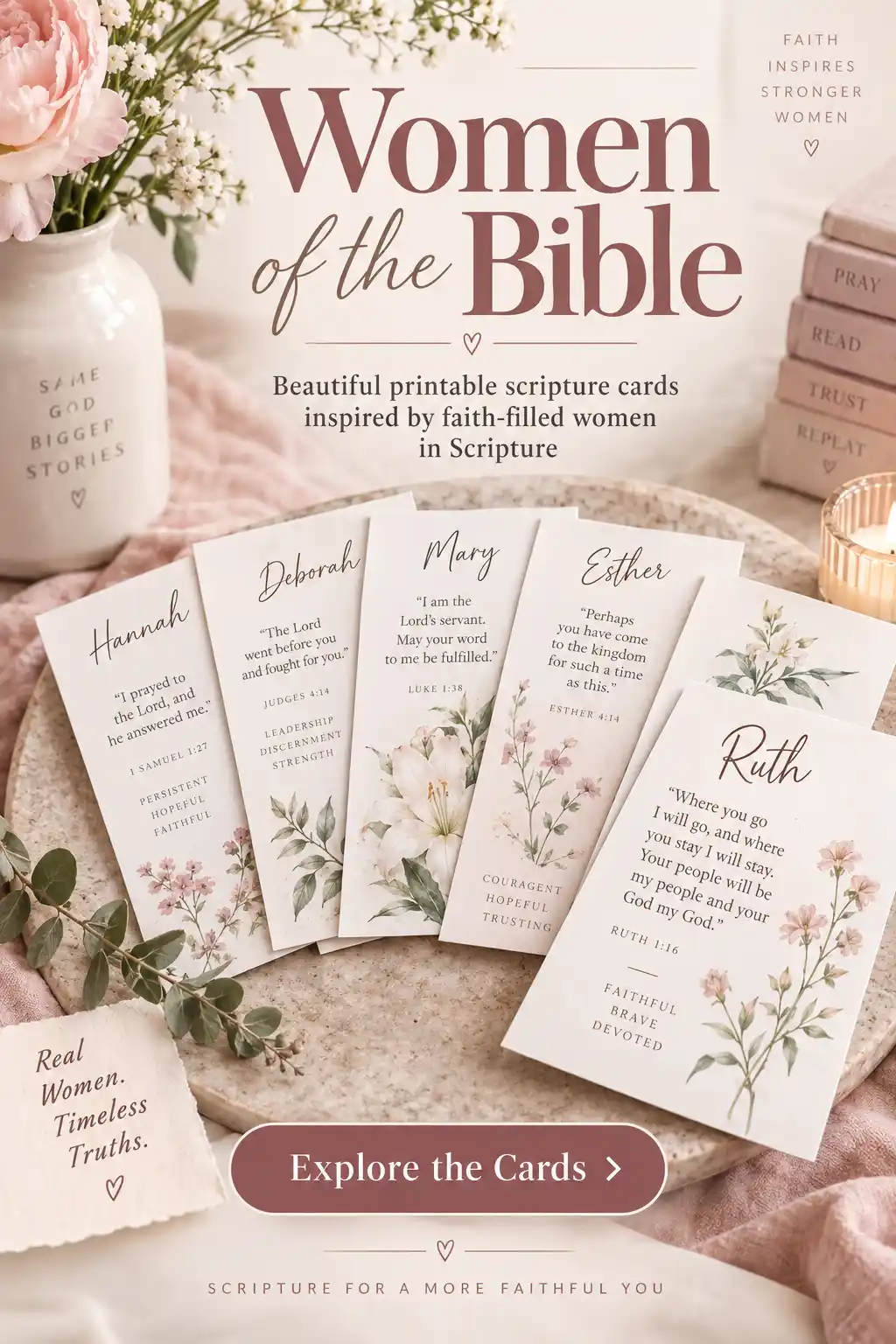
Found a Woman You Want to Study? Keep One of Her Scriptures in View
Choose one passage from the woman whose story speaks to you, then keep it near your Bible, journal, mirror, or desk. The printable cards turn a long article into one verse you can actually revisit through the week.
Choose a Scripture Card for Your Study →Printable format · made for prayer, journaling, encouragement, and meaningful gifting.
Which Woman of the Bible Should You Study First?
A list is useful, but a situation-to-story match is often more helpful. Start with the woman whose biblical setting resembles the question you are actually carrying.
If Martha’s story feels especially familiar, see these Bible verses for feeling overwhelmed.
List of Women in the Bible in Chronological Order: 40 Key Figures
This reference list follows the narrative order of Scripture, from Genesis through the early church. It is designed for readers searching for women of the Bible names, a chronological list of women in the Bible, or a starting point for a character study. It is not an exact calendar timeline—some lives overlap, and several women are known only by a title rather than a personal name.
| Woman | Where to Read | Known For | Study Theme |
|---|---|---|---|
| Eve | Genesis 1–4 | First woman | Dignity, temptation, consequence |
| Sarah | Genesis 12–23 | Mother of Isaac | Promise and waiting |
| Hagar | Genesis 16; 21 | Mother of Ishmael | God sees the vulnerable |
| Rebekah | Genesis 24–27 | Wife of Isaac | Hospitality and family choices |
| Leah | Genesis 29–35 | Mother in Jacob’s family | Rejection and belonging |
| Rachel | Genesis 29–35 | Wife of Jacob | Love, rivalry, longing |
| Tamar | Genesis 38 | Judah’s daughter-in-law | Justice in a broken system |
| Shiphrah | Exodus 1:15–21 | Hebrew midwife | Fear of God over unjust power |
| Puah | Exodus 1:15–21 | Hebrew midwife | Courage and protection of life |
| Jochebed | Exodus 2; 6:20 | Mother of Moses | Courageous motherhood |
| Miriam | Exodus 2; 15; Numbers 12 | Prophetess | Worship, leadership, correction |
| Daughters of Zelophehad | Numbers 27; 36 | Petitioned for inheritance | Justice and lawful advocacy |
| Rahab | Joshua 2; 6; Hebrews 11:31 | Protected Israelite spies | Faith beyond reputation |
| Deborah | Judges 4–5 | Judge and prophetess | Wisdom and courageous leadership |
| Jael | Judges 4–5 | Part of Israel’s deliverance | War narrative and deliverance |
| Naomi | Ruth 1–4 | Ruth’s mother-in-law | Grief and restored hope |
| Ruth | Ruth 1–4 | Moabite in David’s family line | Loyalty and redemption |
| Hannah | 1 Samuel 1–2 | Mother of Samuel | Prayer and surrender |
| Abigail | 1 Samuel 25 | Peacemaker before David | Wisdom and de-escalation |
| Bathsheba | 2 Samuel 11–12; 1 Kings 1–2 | Mother of Solomon | Power, loss, royal succession |
| Widow of Zarephath | 1 Kings 17 | Hosted Elijah | Provision in scarcity |
| Shunammite woman | 2 Kings 4; 8 | Hosted Elisha | Hospitality and grief |
| Huldah | 2 Kings 22:14–20 | Prophetess consulted in Josiah’s reign | Discernment and truth |
| Esther | Esther 1–10 | Queen who risked approaching the king | Courage and advocacy |
| Elizabeth | Luke 1 | Mother of John the Baptist | Faith and encouragement |
| Mary, mother of Jesus | Luke 1–2; John 2; 19 | Mother of Jesus | Faith, obedience, costly discipleship |
| Anna | Luke 2:36–38 | Prophetess in the temple | Long faithfulness |
| Mary Magdalene | Luke 8; John 20 | Disciple and resurrection witness | Healing and faithful witness |
| Martha | Luke 10; John 11–12 | Disciple and host | Service, anxiety, faith |
| Mary of Bethany | Luke 10; John 11–12 | Disciple of Jesus | Attention, grief, devotion |
| Samaritan woman | John 4 | Spoke about Jesus in her town | Grace and testimony |
| Joanna | Luke 8:1–3; 24:10 | Supported Jesus’ ministry | Generosity and witness |
| Susanna | Luke 8:1–3 | Supported Jesus’ ministry | Generosity |
| Tabitha (Dorcas) | Acts 9:36–42 | Disciple known for good works | Practical service |
| Lydia | Acts 16:13–15, 40 | Merchant and host | Hospitality and household faith |
| Damaris | Acts 17:34 | Believer in Athens | Response to the gospel |
| Priscilla | Acts 18; Romans 16 | Coworker with Aquila | Teaching and partnership |
| Phoebe | Romans 16:1–2 | Commended servant of the church | Service and trusted ministry |
| Lois | 2 Timothy 1:5 | Timothy’s grandmother | Generational faith |
| Eunice | 2 Timothy 1:5; 3:15 | Timothy’s mother | Teaching faith at home |
Women of the Bible and Their Stories: Why They Matter
The Bible does not give one stereotype of a “biblical woman.” Its women are mothers and widows, queens and servants, prophets and merchants, immigrants and householders, disciples and patrons. Some are examples of faith; some are warnings; many are complicated people whose stories include both wise and poor choices.
Read in biblical order, their stories also appear at major turning points: Eve at humanity’s beginning; Sarah, Rebekah, Leah, and Rachel in the covenant family; Shiphrah, Puah, Jochebed, Miriam, and Pharaoh’s daughter around Israel’s deliverance from Egypt; Deborah and Jael in the era of the judges; Ruth in the line that leads to David; Esther during the Persian period; Mary at the coming of Jesus; Mary Magdalene at the resurrection; and Lydia, Priscilla, Phoebe, and others in the growth of the early church. That pattern is more useful than treating these women as isolated inspirational quotes.
That variety is important. A strong study of women in the Bible should not flatten Ruth into romance, Esther into a motivational quote, Martha into “the busy woman,” or Proverbs 31 into a productivity checklist. Context makes the stories more useful, not less inspiring.
Important Women of the Old Testament
Eve — Dignity Before the Fall
Genesis 1 gives the broad creation statement; Genesis 2 gives a closer account of the man and woman. The Hebrew word translated “helper” in Genesis 2:18 is ezer, a word also used in the Old Testament for God’s help to his people, so the word itself should not be treated as a synonym for inferiority.
Genesis 3 then records the failure of both human beings. A careful reading does not turn Eve into a symbol for women as a class; it shows the shared human problem of mistrusting God.
Sarah — Faith That Lived Alongside Doubt
Sarah travels with Abraham, waits years for the promised son, laughs when the announcement sounds impossible, and eventually gives birth to Isaac. Hebrews 11 later remembers her within the story of faith. Her life is useful for readers in long seasons of waiting because Scripture does not pretend the wait was emotionally simple.
For shorter encouragement built around similar themes, see encouraging Bible verses for women.
Hagar — Seen in the Wilderness
Hagar is an Egyptian servant drawn into Abraham and Sarah’s family conflict. Genesis 16 and 21 do not hide the mistreatment, fear, or vulnerability around her. In the wilderness, God meets her directly and gives promises concerning her son. Her story is especially significant for readers who feel overlooked because the biblical scene itself places attention on someone others have pushed aside.
Shiphrah and Puah — Courage Under an Unjust Command
In Exodus 1:15–21, Pharaoh orders Hebrew baby boys killed. Shiphrah and Puah refuse. The text says they feared God, and it treats their protection of life positively. Their names are preserved while the Pharaoh in the story is left unnamed—a striking narrative contrast.
Miriam — Prophetess, Worship Leader, and Corrected Sister
Exodus 15:20 calls Miriam a prophetess and shows her leading women in song after the Red Sea. Numbers 12 later records her speaking against Moses and receiving discipline. Micah 6:4 remembers Miriam alongside Moses and Aaron in Israel’s deliverance story. That combination makes her more instructive than a one-dimensional “strong woman” label.
Rahab — Faith Beyond Reputation
Rahab protects the Israelite spies in Joshua 2, survives Jericho’s destruction, appears in Hebrews 11’s faith chapter, and is named in Matthew 1:5 within Jesus’ genealogy. Her story is one of the clearest biblical challenges to the belief that a person’s past must permanently define their future.
Deborah — Prophetess and Judge
Israel came to Deborah for judgment. She summoned Barak and delivered God’s command concerning Sisera. When Barak asked her to go with him, she went. Judges 5 then preserves the victory song associated with Deborah and Barak. Christian traditions differ on how Deborah’s example relates to church office today, but the narrative itself is clear about the role she held in Israel.
Ruth and Naomi — Loyalty Inside Grief
Ruth is a Moabite widow who chooses Naomi’s people and God. Naomi begins the book naming her bitterness and loss. Their story eventually includes Boaz, redemption, a restored household, and Ruth’s place in the family line of David. The story is richer when the grief at the beginning is not skipped.
Ruth 1:16 is often used in weddings. It can work beautifully there, but the original relationship is not romantic. If you plan to use it in a card, see our guide to Bible verses for wedding cards.
Hannah — Prayer Without Pretending
Hannah’s pain, misunderstanding, vow, answered prayer, and song in 1 Samuel 1–2 make her one of Scripture’s most important prayer stories. Her praise also anticipates themes that later appear in Mary’s song in Luke 1.
Abigail — Wisdom That Prevented Bloodshed
In 1 Samuel 25, David is on his way to retaliate violently against Nabal’s household. Abigail meets him with gifts, humility, and a carefully reasoned appeal. David changes course. The story is a practical study in peacemaking, timing, courage, and restraint.
Esther — Courage Used for Other People
Esther is a Jewish woman living in the Persian Empire who becomes queen. When Haman’s decree threatens her people, Mordecai challenges her to act. Esther calls for a fast and decides to approach the king despite the risk. Her courage is purposeful because it is directed toward the survival of others.
Important Women of the New Testament
Mary, the Mother of Jesus — Faith Without Full Information
Luke presents Mary not only as Jesus’ mother but as a thoughtful believer whose song in Luke 1:46–55 is saturated with biblical themes. She appears again at key points in Jesus’ life, including John 2 and the crucifixion scene in John 19.
Elizabeth and Anna — Long Faithfulness
Elizabeth’s blessing of Mary in Luke 1:41–45 models generous encouragement. Anna, identified as a prophetess in Luke 2:36–38, has spent years in worship and fasting before recognizing the infant Jesus and speaking about him to others waiting for redemption.
Mary and Martha of Bethany — Devotion, Service, Grief, and Faith
Luke 10:38–42 is often reduced to “Mary good, Martha bad.” The text is more precise: Martha is anxious and troubled by many things while Mary listens to Jesus. In John 11, both sisters grieve Lazarus differently, and Jesus meets both of them in their sorrow.
Mary Magdalene — Faithful Witness to the Resurrection
Luke 8:1–3 says Jesus had freed Mary Magdalene from seven demons and that she was among women supporting the ministry. The Gospels place her at the crucifixion and tomb, and John 20 describes Jesus appearing to her after the resurrection and sending her to tell the disciples. The prostitute identification comes from later tradition, not from the biblical text.
The Samaritan Woman — A Testimony That Moved a Town
After speaking with Jesus, she goes into the town and tells people what happened. John 4:39 says many Samaritans believed because of the woman’s testimony. Her story is a reminder that testimony can begin immediately with what a person has genuinely encountered.
Tabitha, Lydia, Priscilla, and Phoebe — Everyday Ministry in the Early Church
Tabitha (Dorcas) Acts 9:36–42 calls her a disciple known for good works and acts of mercy. Her sewing and care for widows are treated as meaningful Christian service.
Lydia Acts 16 describes a merchant in purple cloth who responds to Paul’s message, is baptized with her household, and opens her home. Her house later appears as a gathering point for believers.
Priscilla Acts 18 shows Priscilla and Aquila explaining the way of God more accurately to Apollos. Paul later calls them fellow workers.
Phoebe Romans 16:1–2 commends Phoebe as a diakonos of the church at Cenchreae and a helper/patron of many. Many scholars infer that she carried Paul’s letter to Rome, but Romans 16 does not explicitly state that detail, so it is best treated as a plausible historical inference rather than a direct biblical claim.
Women in the Bible Who Overcame Hardship and Obstacles
Readers often look for female Bible characters who overcame obstacles, but the strongest stories are not simple “success stories.” These women faced grief, displacement, infertility, danger, social vulnerability, scarcity, or a painful past. Scripture shows what faith can look like inside those pressures rather than promising that every hardship ends quickly.
| Woman | Obstacle or Pressure | What Her Story Shows | Where to Read |
|---|---|---|---|
| Hagar | Displacement and vulnerability in the wilderness | God sees a person others can overlook | Genesis 16; 21 |
| Hannah | Infertility, grief, and repeated provocation | Prayer can be honest without becoming performative | 1 Samuel 1–2 |
| Ruth | Bereavement, migration, and economic insecurity | Loyalty and steady work can coexist with grief | Ruth 1–4 |
| Abigail | A dangerous household crisis created by Nabal | Wisdom and timely speech can interrupt escalating harm | 1 Samuel 25 |
| Esther | Risk to her own safety while her people faced destruction | Courage becomes meaningful when it is used for others | Esther 4–9 |
| Widow of Zarephath | Famine and near-total scarcity | Her story holds trust and provision together without denying the severity of need | 1 Kings 17 |
| Mary Magdalene | A past marked by severe affliction | Her past does not erase her place as a devoted disciple and resurrection witness | Luke 8:1–3; John 20 |
Carry One Verse Into the Hard Season You’re Actually In
You do not need another long list to remember. Pick one passage connected to courage, waiting, grief, identity, or hope and keep it somewhere you will see it. That is the purpose of these printable Scripture cards.
Find a Verse for the Season You’re In →A gentle bridge from reading the story to returning to Scripture during the week.
Powerful, Strong, Faithful, and Virtuous Women of the Bible
If you are looking for powerful women in the Bible, it helps to define what “powerful” means in the text. There is no biblical ranking of the “most powerful woman,” because Scripture presents power and strength in different forms. Deborah exercised public leadership; Esther used access and courage to advocate for her people; Huldah spoke prophetically to royal officials; Abigail used wisdom to stop bloodshed; Lydia used resources and hospitality; Priscilla helped explain the way of God more accurately; and Mary Magdalene remained a faithful witness at the resurrection. Biblical strength can look like leadership, endurance, discernment, loyalty, generosity, prayer, or costly courage.
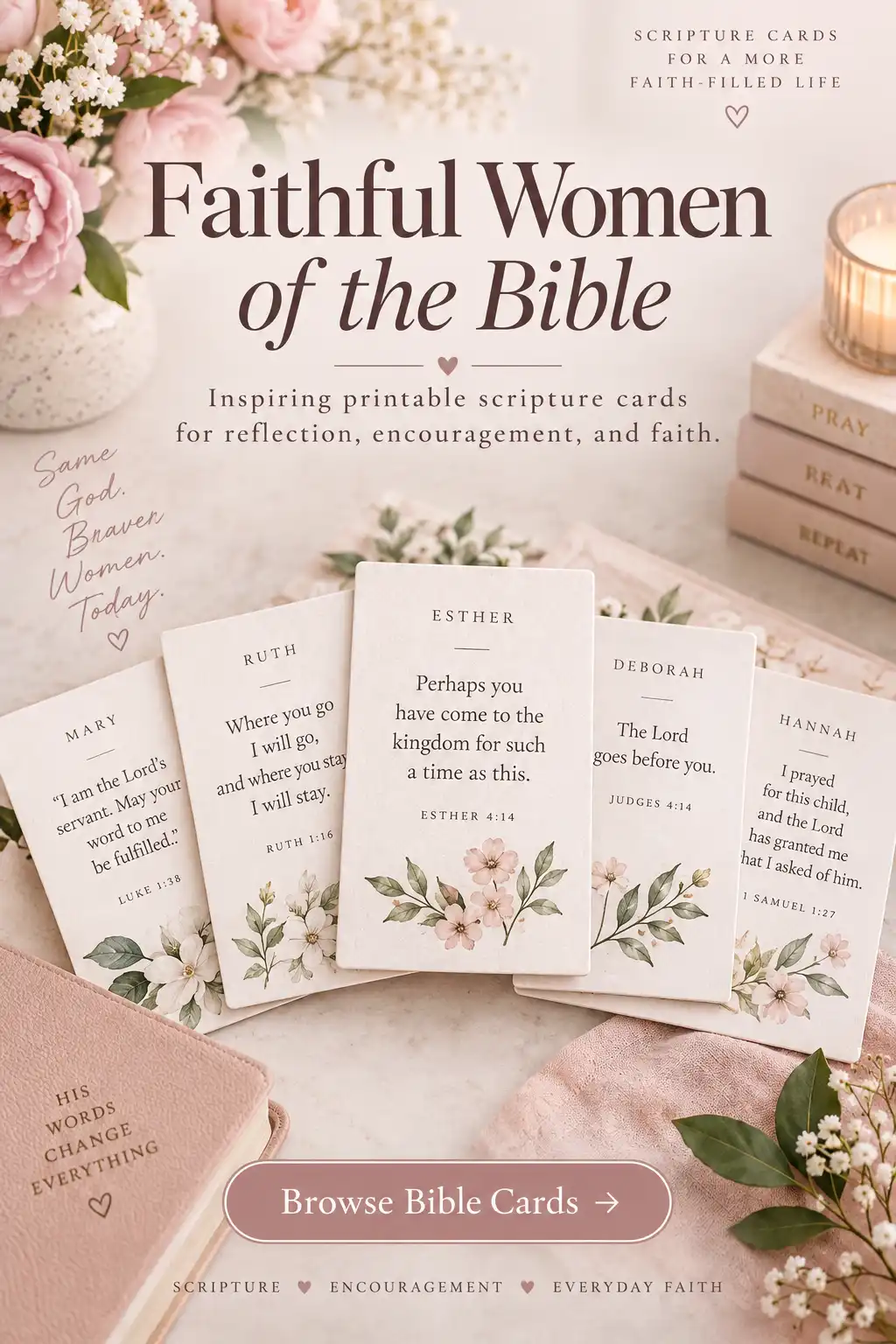
Turn One Lesson From These Women Into a Daily Scripture Reminder
Deborah’s courage, Ruth’s loyalty, Hannah’s prayer, Esther’s responsibility, and Mary’s trust are easier to revisit when the Scripture is visible. Choose a card that matches the lesson you want to carry beyond this page.
Choose a Faith-Focused Scripture Card →Use it beside your Bible, in a journal, on a desk, or as an encouraging note for another woman.
What About the Proverbs 31 Woman?
Proverbs 31:10–31 is an alphabetic acrostic poem praising a capable woman. It is better read as a portrait of mature wisdom than as a daily productivity scorecard. Seven recurring qualities in the poem are:
| Quality | Reference | What the Poem Praises |
|---|---|---|
| Trustworthiness | Proverbs 31:11 | A life others can safely rely on |
| Diligence | 31:13, 17 | Purposeful work and strength |
| Discernment | 31:16 | Thoughtful decision-making |
| Generosity | 31:20 | Open hands toward people in need |
| Strength and dignity | 31:25 | Steadiness toward the future |
| Wisdom in speech | 31:26 | Wise and kind words |
| Fear of the Lord | 31:30 | The spiritual center of the portrait |
Verse 30 is the anchor: external charm and beauty are temporary, while reverence for God is praised. For related Scripture on identity and courage, see Bible verses about confidence.
Women Who Led, Prophesied, Taught, and Served
The Bible records women serving God in different settings. The safest approach is to describe what each passage says before importing a modern title into the text.
| Woman | What the Text Reports | Passage |
|---|---|---|
| Miriam | Called a prophetess and led women in worship | Exodus 15:20–21 |
| Deborah | Prophetess and judge in Israel | Judges 4:4–5 |
| Huldah | Prophetess consulted during Josiah’s reign | 2 Kings 22:14–20 |
| Anna | Prophetess who spoke about Jesus | Luke 2:36–38 |
| Samaritan woman | Told her town about Jesus | John 4:28–30, 39 |
| Priscilla | With Aquila, explained God’s way to Apollos | Acts 18:24–26 |
| Phoebe | Commended as a diakonos of the church at Cenchreae | Romans 16:1–2 |
| Daughters of Philip | Four daughters who prophesied | Acts 21:8–9 |
Popular Verses About Women That Are Often Taken Out of Context
Genesis 2:18 — “A helper suitable for him”
The Hebrew word ezer is used elsewhere in the Old Testament for help that comes from God. The word itself does not define a person as inferior. Any theology built from Genesis 2 should account for the whole creation narrative, including Genesis 1:27.
Ruth 1:16 — “Where you go, I will go”
This is spoken to Naomi, not to a romantic partner. It is a declaration of loyalty in the middle of bereavement and migration. That original setting makes its use in friendship or marriage more meaningful when the context is acknowledged.
Esther 4:14 — “For such a time as this”
Mordecai is not giving Esther a generic confidence slogan. He is confronting her with responsibility while her people face destruction. The verse is about costly courage used for others.
Proverbs 31 — A checklist for doing everything
The passage is poetry, specifically an alphabetic acrostic. It praises character, wisdom, stewardship, generosity, and fear of the Lord. Treating every line as a daily household checklist misses the literary form.
Submission texts in dangerous relationships
Biblical teaching about marriage should never be weaponized to keep a person in immediate physical danger or to shield abuse from accountability. A passage about Christian character is not permission for violence, coercion, or criminal behavior.
Warning Stories: Women Scripture Does Not Present as Models
The Bible includes cautionary stories about women just as it does about men. Those stories should be read as warnings about particular sins and choices—not as arguments about women in general.
- Lot’s wife — Genesis 19:26; remembered by Jesus in Luke 17:32.
- Delilah — Judges 16; betrayal and Samson’s repeated self-destructive choices.
- Potiphar’s wife — Genesis 39; false accusation and Joseph’s integrity.
- Jezebel — 1 Kings 18–21; idolatry, abuse of power, and injustice.
- Athaliah — 2 Kings 11; violent seizure of power.
- Herodias — Mark 6:17–29; resentment toward John the Baptist’s rebuke.
“Jezebel” in particular is sometimes used casually as an insult toward women. The biblical passages indict concrete idolatry, injustice, and abuse of power; they do not authorize using the name as a gendered slur.
A Simple 4-Week Women of the Bible Study Plan
For every session, read the full chapter or narrative unit, note what the text actually says, identify what it does not say, and only then write a personal application. That habit alone prevents many common misreadings.
If you prefer shorter passages for memorization or journaling, choose one key verse from the woman you are studying and return to it throughout the week.
Frequently Asked Questions About Women of the Bible
Who are the 12 women of the Bible most often studied?
A practical list of twelve frequently studied women is Eve, Sarah, Hagar, Miriam, Rahab, Deborah, Ruth, Hannah, Abigail, Esther, Mary the mother of Jesus, and Mary Magdalene. The Bible itself does not establish an official group of twelve women, so different studies may substitute Rebekah, Martha, Lydia, Priscilla, or others.
Who are the significant women in the Bible?
Significant women include matriarchs such as Sarah and Rebekah; leaders and prophetesses such as Miriam, Deborah, Huldah, and Anna; courageous figures such as Rahab and Esther; disciples such as Mary Magdalene, Mary of Bethany, and Martha; and early-church coworkers such as Lydia, Priscilla, and Phoebe.
What are 7 qualities of a good or godly woman in the Bible?
Proverbs 31 highlights trustworthiness, diligence, discernment, generosity, strength and dignity, wisdom in speech, and fear of the Lord. Other biblical women add qualities such as courage, loyalty, hospitality, prayer, and perseverance.
Who are five well-known women of the Bible?
Five widely recognized examples are Eve, Ruth, Esther, Mary the mother of Jesus, and Mary Magdalene. For a balanced study, add Deborah for leadership, Hannah for prayer, Rahab for faith, and Lydia for early-church hospitality.
Who was the most powerful woman in the Bible?
The Bible does not rank women by power. Deborah is a clear example of public leadership as a judge and prophetess; Esther used royal access and personal risk to advocate for her people; Huldah delivered a prophetic word to royal officials; and Priscilla, Lydia, and Phoebe are important women in the early church. The best answer depends on whether you mean political influence, spiritual leadership, courage, wisdom, or endurance.
Was Mary Magdalene a prostitute?
No. The Bible never identifies Mary Magdalene as a prostitute. Luke 8 says Jesus had freed her from seven demons, and the Gospels present her as a devoted follower and resurrection witness. The prostitute identification comes from later tradition.
How many women are named in the Bible?
There is no universally agreed total because counts vary by biblical canon, duplicate names, variant spellings, and whether uncertain or repeated identities are treated as one person or several. For study purposes, it is more reliable to use a clearly defined list than to present one disputed number as absolute.
Which books of the Bible are named after women?
Ruth and Esther are the two books in the standard Protestant Old Testament named after women. Ruth centers on loyalty, family redemption, and the line of David; Esther centers on Jewish survival in the Persian Empire and courageous advocacy.
How This Guide Was Built
This resource is intentionally broader than a “12 inspiring women” list. Figures were selected for their importance to the biblical narrative and for the questions readers repeatedly bring to this topic: who the women were, where they appear, how their stories fit the biblical timeline, which women showed courage or leadership, and what their passages actually teach in context. That is why the guide combines a chronological reference list with deeper character studies instead of forcing every related query into a separate thin page.
Where Christians genuinely disagree—especially around women and church office—the article describes the biblical role first and identifies the existence of interpretation differences instead of presenting one tradition as universally settled. Exact quotations are from the World English Bible; eBible.org identifies the WEB as public domain. For an additional thematic study of women in Exodus 1–2, BibleProject’s study of seven women in Exodus is a useful companion resource.
The women of Scripture are not one type of person. They are widows, mothers, foreigners, servants, queens, merchants, prophets, disciples, hosts, and witnesses. Their stories are worth studying precisely because the Bible does not reduce them to one mold. Read them in context, notice both courage and complexity, and let the text—not a stereotype—shape the lesson.
Pingback: Birth of Jesus: Bible Story, Date, Bethlehem & Meaning
Pingback: verses about daughters in the Bible -