
Birth of Jesus: The Bible Story, When & Where He Was Born, and What It Means
The birth of Jesus is more than a familiar Christmas scene. Matthew and Luke tell complementary parts of the Nativity: Mary and Joseph, Bethlehem, the manger, shepherds, Magi, Herod, the temple, Egypt, and Nazareth. This guide keeps those Gospel details distinct, answers the biggest date-and-place questions, and separates what Scripture actually says from later Nativity tradition.
Quick Answer
The Bible places the birth of Jesus in Bethlehem of Judea and tells the story mainly in Matthew 1–2 and Luke 1–2. Mary conceived Jesus through the Holy Spirit, Joseph received angelic guidance, Jesus was laid in a manger, shepherds came after an angelic announcement, and Magi later came to worship Him. Scripture gives no exact birthday or month; historians commonly place His birth several years before AD 1.
Where Should You Start in the Birth of Jesus Story?
The fastest way to understand the Nativity is to start with the Gospel passage that answers your question. Matthew and Luke overlap at important points, but each preserves material the other does not.
Birth of Jesus at a Glance
| Question | Best concise answer | Key Bible reference |
|---|---|---|
| Where was Jesus born? | Bethlehem in Judea. | Matthew 2:1; Luke 2:4–7 |
| Who was His mother? | Mary. | Matthew 1:18; Luke 1:26–35 |
| Who was Mary betrothed to? | Joseph, a descendant of David. | Matthew 1:18–20; Luke 1:27 |
| Where was the baby placed? | In a manger, or feeding trough. | Luke 2:7 |
| Who visited after the angelic announcement? | Shepherds. | Luke 2:8–20 |
| Who followed the star? | Magi from the East; Matthew does not give their number. | Matthew 2:1–12 |
| Was Jesus born December 25? | The Bible does not give an exact day or month. | No Gospel verse states a calendar date |
| What is Jesus’ birth commonly called? | The Nativity of Jesus, or Nativity of Christ. | Christian usage for the Gospel birth narratives |
The Full Birth of Jesus Story in the Bible
No single Gospel chapter contains every scene people associate with Christmas. A complete biblical overview comes from reading Matthew 1–2 together with Luke 1–2. The sequence below is a careful synthesis; each step is labeled with its Gospel source so the two accounts are not accidentally blended into one.
In Nazareth, Gabriel tells Mary that she will conceive a son named Jesus. Luke says the child will be called the Son of the Most High and that His kingdom will have no end. When Mary asks how this can happen because she is a virgin, Gabriel attributes the conception to the Holy Spirit and the power of the Most High.
Mary’s response belongs within the wider biblical story of women whose faith is recorded in Scripture. For that broader context, see our guide to the women of the Bible and their stories.
Matthew tells the story from Joseph’s side. When Mary is found pregnant before they come together, Joseph plans to end the betrothal quietly. An angel tells him not to fear taking Mary as his wife because the conception is from the Holy Spirit.
Why the name matters: Matthew connects the name “Jesus” directly with His saving mission. The birth narrative is already telling the reader who this child is and why His life matters.
Luke places the journey in the setting of a registration associated with Caesar Augustus and Quirinius. Joseph goes from Nazareth in Galilee to Bethlehem, the city of David, because he belongs to David’s house and family line; Mary travels with him while pregnant.
While they are in Bethlehem, Mary gives birth to her firstborn son, wraps Him in cloths, and lays Him in a manger because suitable guest space is unavailable. Luke explicitly gives us the manger. It does not explicitly describe an innkeeper, a wooden barn, a donkey, or animals gathered around the baby.
Shepherds are watching flocks in fields near Bethlehem when an angel announces “good news of great joy.” The sign is not a star: it is a baby wrapped in cloths and lying in a manger. The shepherds go to Bethlehem, find Mary, Joseph, and the baby, then spread what they were told.
Luke continues beyond the manger. Jesus is circumcised and named, then Mary and Joseph take Him to Jerusalem. Simeon recognizes the child and praises God; Anna, a prophetess, speaks about Him to people waiting for Jerusalem’s redemption.
Matthew says Magi arrive in Jerusalem after Jesus has been born, asking for the one born “King of the Jews.” Herod consults the chief priests and scribes, who point to Bethlehem. The Magi follow the star and enter a house, where they see the child with Mary and present gold, frankincense, and myrrh.
After the Magi leave by another route, Joseph is warned in a dream to flee. Matthew then tells of Herod’s violent action against young children in Bethlehem and its district. This is one reason the Magi scene should not automatically be collapsed into the exact night of Jesus’ birth.
Both infancy narratives eventually locate Jesus’ childhood in Nazareth, although they reach that point through different selected events.
Matthew vs. Luke: What Each Gospel Says About Jesus’ Birth
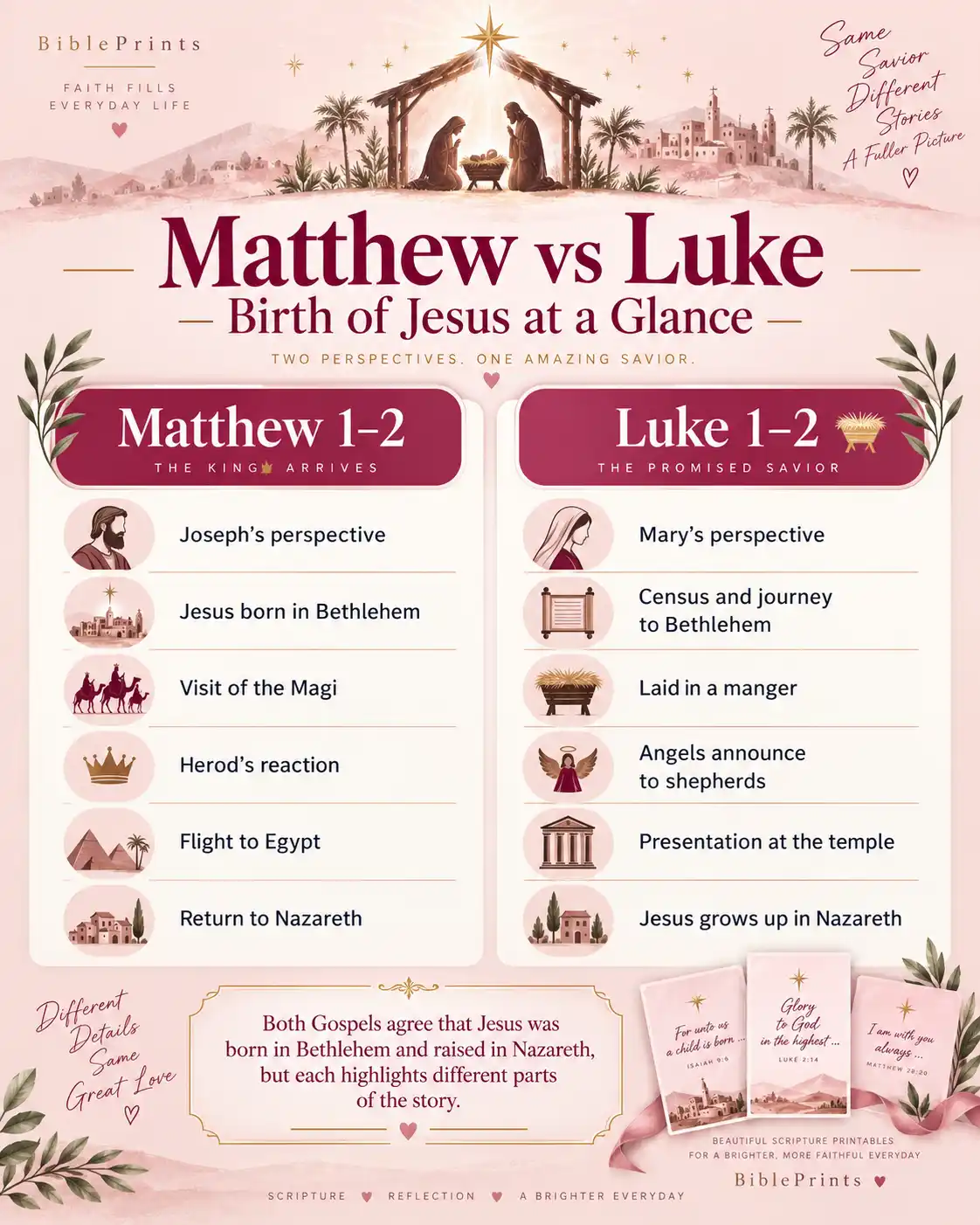
One of the easiest ways to read the Nativity accurately is to stop asking “Which Gospel has the Christmas story?” and ask “What does each Gospel contribute?” The accounts share a central core but emphasize different people, scenes, and theological themes.
| Birth-story detail | Matthew 1–2 | Luke 1–2 |
|---|---|---|
| Announcement focus | Joseph receives an angelic dream. | Gabriel speaks directly to Mary. |
| Conception | Attributed to the Holy Spirit. | Attributed to the Holy Spirit / power of the Most High. |
| Place of birth | Bethlehem in Judea. | Bethlehem, city of David. |
| Birth setting | Does not narrate the delivery itself. | Swaddling cloths and manger. |
| Visitors | Magi from the East. | Shepherds from nearby fields. |
| Sign | Star connected with the Magi. | Angelic announcement; baby in manger is the sign. |
| Political figures | Herod the Great. | Caesar Augustus; Quirinius is named in the census setting. |
| Jerusalem / temple | Herod, chief priests and scribes. | Presentation; Simeon and Anna. |
| Threat and escape | Herod; flight to Egypt. | Not narrated. |
| End of infancy sequence | Family settles in Nazareth. | Family returns to Nazareth; later Jesus visits Jerusalem at age twelve. |
What do Matthew and Luke agree on?
Both identify Mary and Joseph, connect Jesus with Davidic expectation, attribute His conception to divine action before Mary and Joseph come together, place His birth in Bethlehem, and ultimately associate His upbringing with Nazareth. Their distinctive scenes should not be treated as if one writer had simply copied the other.
Where Was Jesus Born?
According to Matthew and Luke, Jesus was born in Bethlehem in Judea. Bethlehem lies south of Jerusalem and is deeply connected with King David in the Old Testament. That Davidic association is important inside the Gospel narratives: Luke calls Bethlehem the “city of David,” and Matthew cites Micah while discussing where the Messiah was expected to be born.
Bethlehem’s biblical importance reaches well before the Nativity: it is associated with Ruth and with David’s family and kingship. That background helps explain why both “Bethlehem” and “city of David” carry more meaning in the birth narratives than simple geography.
Was Jesus born in a stable, cave, house, or inn?
The safest answer is: Luke explicitly says Jesus was laid in a manger, but it does not name the exact building. A manger strongly suggests a space associated with feeding animals, yet the Gospel does not say “wooden stable,” describe an innkeeper, or name a cave.
An ancient Christian tradition identifies a cave beneath the Church of the Nativity in Bethlehem with Jesus’ birthplace. UNESCO describes the site as a place identified by Christian tradition with Jesus’ birth since at least the second century; a church was completed there in the fourth century. That is valuable historical evidence for an early tradition, but it should not be confused with a detail explicitly stated in Matthew or Luke.
When Was Jesus Born?
The Bible does not give Jesus’ exact birth date, month, or calendar year. The Gospels provide historical anchors, but those anchors do not produce a universally agreed date. This is why responsible answers distinguish what the text says from later calculations and scholarly reconstruction.
What year was Jesus born?
A common historical estimate places Jesus’ birth several years before AD 1, often around 6–4 BC/BCE. Matthew places the birth during the reign of Herod the Great, and Herod is commonly dated to have died in 4 BC/BCE. The numbering system that later produced BC and AD was created centuries after Jesus, so it should not be surprising that its starting point does not align perfectly with the historical estimate.
Was Jesus born in the year 0?
No. The traditional BC/AD calendar has no year 0: 1 BC is followed by AD 1. More importantly, the Gospel chronology is generally understood to place Jesus’ birth before AD 1 anyway. Using the common 6–4 BC range, His birth was roughly 2,029 to 2,031 years before 2026—so “about 2,030 years ago” is a reasonable rounded answer.
What about Luke’s census and Quirinius?
Luke 2 connects the Bethlehem journey with a registration and names Quirinius in Syria. Historians have long discussed how that wording relates to other chronology, because the best-known census under Quirinius is usually dated later than Herod’s reign. Different harmonizations and critical explanations have been proposed; there is no universally accepted reconstruction that gives us an exact birth year. For a critical historical overview of the issue, see Oxford Academic’s chronology discussion.
Was Jesus born on December 25?
The Gospels never say Jesus was born on December 25. December 25 is the traditional Western Christian celebration of the Nativity. Early Christians proposed multiple dates, and December 25 became established as a feast in late antiquity. The Biblical Archaeology Society’s history of December 25 notes both the lack of a Gospel date and the development of the later celebration.
If you are looking specifically for Scripture to read, share, or place in a card during the Christmas season, use our separate guide to Christmas Bible verses. This page stays focused on the birth event itself.
Was Jesus born in September—or another month?
Several proposed chronologies try to infer a season from priestly schedules, shepherding practices, or other clues. Those theories can be interesting, but none should be presented as a date stated by Scripture. The Gospel writers do not identify Jesus’ birth month.
What Does the Bible Actually Say—and What Comes From Nativity Tradition?
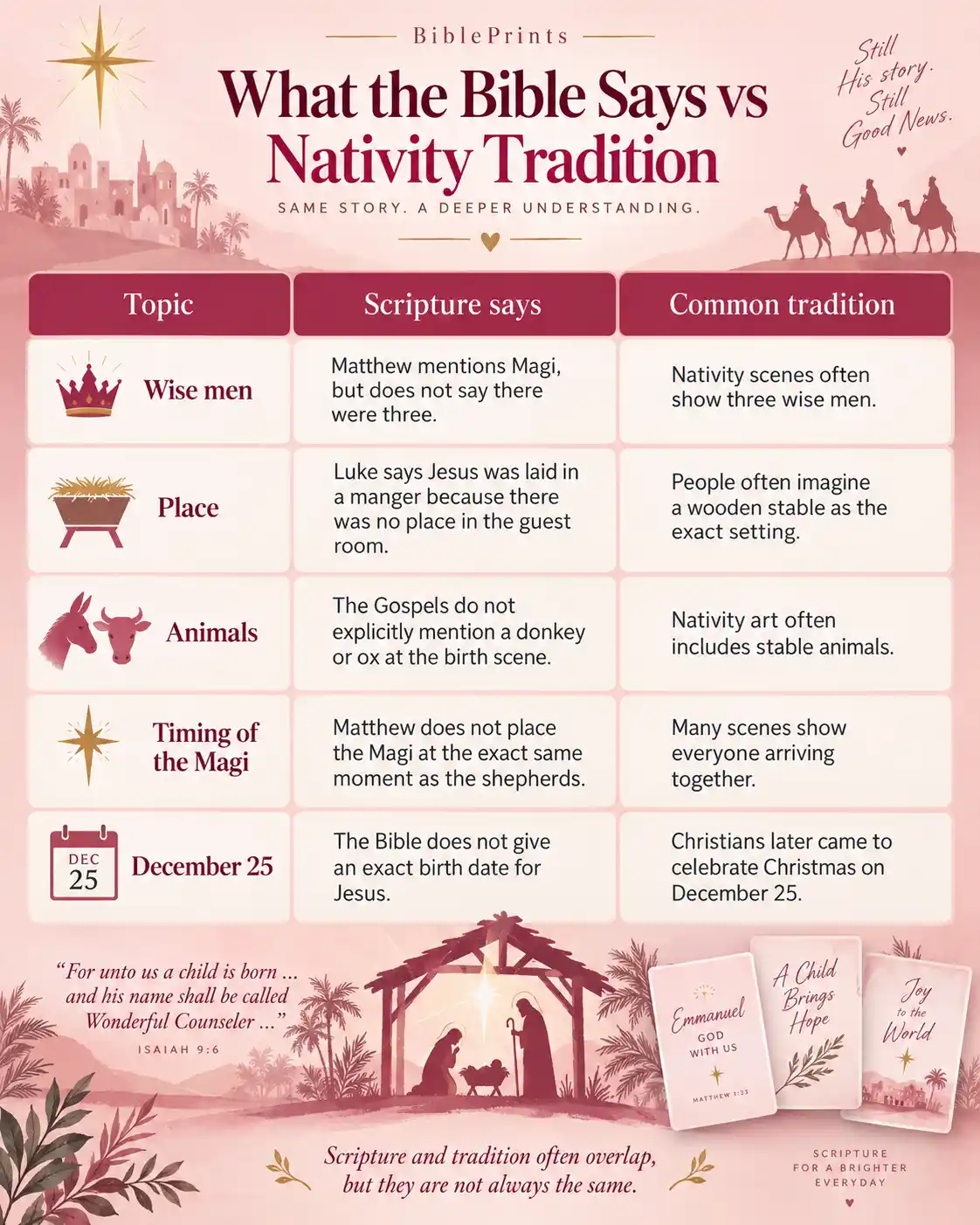
Nativity art and Christmas pageants often combine Matthew, Luke, later tradition, and artistic imagination. That can create a beautiful scene, but it is useful to know which details come directly from the text.
| Common Nativity detail | What the Bible says | Best conclusion |
|---|---|---|
| Mary rode a donkey to Bethlehem. | Luke says Mary traveled with Joseph but does not name the animal or transport. | Possible in imagination; not stated. |
| An innkeeper turned them away. | Luke says no suitable room/place was available; no innkeeper is mentioned. | Later retelling detail. |
| Jesus was born in a wooden stable. | Luke explicitly gives a manger, not the architecture. | Animal-related setting is plausible; exact structure is unknown. |
| There were animals beside the manger. | The Gospels do not list animals at the birth scene. | Traditional imagery, not explicit Gospel detail. |
| Three kings visited Jesus. | Matthew says Magi from the East and lists three gifts; it gives no number and does not call them kings. | “Three wise men/kings” is later tradition. |
| The Magi arrived the same night as the shepherds. | Luke places the shepherds with the baby and manger. Matthew says the Magi later enter a house and see the child. | Do not assume the visits were simultaneous. |
| The shepherds followed the star. | The star belongs to Matthew’s Magi account; shepherds receive an angelic announcement in Luke. | Two different signs in two Gospel narratives. |
| Jesus was born December 25. | No Gospel gives a calendar date. | December 25 is a Christian feast date, not a stated biblical birthday. |
| Mary was a specific teenage age. | Scripture never states Mary’s age. | Any exact age is historical reconstruction, not a biblical number. |
Key Bible Verses About the Birth of Jesus
For the strongest study, read the full sections rather than isolating one Christmas line. These passages form the core biblical birth-of-Jesus resource set.
A strong way to study passages like these is to read the surrounding chapter, identify which Gospel supplies each detail, and compare parallel accounts before drawing conclusions from an isolated verse.
Old Testament Passages Connected With Jesus’ Birth
Christians often describe the Nativity as fulfillment of Old Testament prophecy. That is true to Matthew’s own way of telling the story, but not every Old Testament text functions in exactly the same way. The strongest reading asks how the Gospel writer uses the passage rather than treating every connection as an identical prediction formula.
| Old Testament passage | New Testament use | Important context |
|---|---|---|
| Isaiah 7:14 | Matthew 1:22–23 applies the Immanuel text to Jesus’ conception and birth. | Matthew explicitly makes the connection; readers should still recognize Isaiah’s original historical setting. |
| Micah 5:2 | Matthew 2:5–6 uses the Bethlehem text when Herod asks where the Messiah is to be born. | Bethlehem is tied to Davidic expectation and rulership. |
| Hosea 11:1 | Matthew 2:15 applies “out of Egypt I called my son” to Jesus’ return from Egypt. | Hosea originally recalls Israel’s exodus; Matthew uses it typologically in Jesus’ story. |
| Jeremiah 31:15 | Matthew 2:17–18 connects Rachel’s weeping with the tragedy around Bethlehem. | Jeremiah’s wider chapter moves from grief toward restoration; Matthew reuses the image in a new event. |
Why this matters for AEO-level accuracy: saying “Matthew applies this text to Jesus” is more precise than flattening four different Old Testament contexts into one identical kind of prediction.
Names and Titles Surrounding Jesus’ Birth
Why the Birth of Jesus Matters in Christianity
The Nativity is not important merely because Christianity remembers the beginning of Jesus’ earthly life. The New Testament interprets His coming as part of the larger story of God’s saving action.
1. Incarnation: the Word became flesh
John does not narrate a manger, shepherds, or Magi, but John 1:14 gives the theological center Christians call the Incarnation: the eternal Word “became flesh.” The Christian claim is not simply that a remarkable teacher was born, but that God’s self-revelation entered human life.
2. Salvation is already named at the beginning
Matthew 1:21 connects Jesus’ name with saving His people from their sins. Luke 2:11 calls Him “a Savior.” The Gospel writers therefore frame Jesus’ mission before His public ministry begins.
3. Jesus is presented as David’s promised king
Joseph’s Davidic descent, Bethlehem as David’s city, Gabriel’s promise of David’s throne, and the Magi’s royal question all make kingship a major birth-story theme.
4. The good news reaches both the lowly and the distant
Luke gives nearby shepherds the angelic announcement; Matthew gives eastern Magi a journey of worship. The narratives are not identical, but together they widen the social and geographic horizon of the story.
5. Birth, redemption, and adoption belong to one story
Galatians 4:4–5 says that when the fullness of time came, God sent His Son, “born to a woman,” with redemption and adoption in view. The birth is therefore the beginning of the Gospel story, not an isolated holiday episode.
What We Know, What Is Probable, and What Remains Unknown
Matthew and Luke both place Jesus’ birth in Bethlehem of Judea.
Luke explicitly says the newborn Jesus was laid in a manger / feeding trough.
Shepherds appear in Luke; Magi and the star appear in Matthew.
Herod’s reign is a major reason scholars place the birth before the calendar’s AD starting point.
A Bethlehem cave site has been associated with the birth in Christian tradition since at least the second century.
No Gospel gives the day or month of Jesus’ birth.
The manger is clear; wooden stable, cave, barn, and innkeeper details are not specified by the Gospel text.
Neither number appears in Matthew or Luke.
A Simple 4-Day Nativity Reading Plan
This is not a substitute for reading the Gospels in full. It is a compact way to study the birth story without collapsing Matthew and Luke into one scene.
- Day 1 — Luke 1:26–56: Mary, Gabriel, Elizabeth, and Mary’s praise.
- Day 2 — Matthew 1:18–25 + Luke 2:1–20: Joseph’s dream, Bethlehem, manger, angels, and shepherds.
- Day 3 — Luke 2:21–38: naming, presentation, Simeon, and Anna.
- Day 4 — Matthew 2: Magi, Herod, Egypt, and Nazareth.
At the end of each day, write one sentence answering: What does this passage explicitly say about Jesus? Then write a second sentence: Which detail did I previously assume was in the text? That two-question habit is a simple way to read the Nativity more carefully.
Frequently Asked Questions About the Birth of Jesus
What is the full story of Jesus’ birth?
The full biblical birth story is assembled mainly from Matthew 1–2 and Luke 1–2. Luke tells of Gabriel’s announcement to Mary, the journey to Bethlehem, Jesus in the manger, shepherds, and the temple presentation; Matthew tells Joseph’s dream, the Magi, Herod, the flight to Egypt, and the family’s settlement in Nazareth.
What Bible verses mention the birth of Jesus?
The core passages are Luke 1:26–38, Matthew 1:18–25, Luke 2:1–20, Luke 2:21–38, and Matthew 2:1–23. John 1:14 and Galatians 4:4–5 do not retell the Nativity scene but explain the incarnation and redemptive meaning of Jesus’ coming.
Was Jesus born on December 25?
The Bible does not say that Jesus was born on December 25. December 25 is the traditional Western Christian date for celebrating the Nativity, while the Gospel accounts themselves do not identify Jesus’ exact day or month of birth.
What year was Jesus born?
No exact year can be proven from the Gospel accounts. A common historical estimate is around 6–4 BC/BCE, several years before AD 1, largely because Matthew places Jesus’ birth during the reign of Herod the Great.
Where was Jesus born?
Matthew and Luke both say Jesus was born in Bethlehem in Judea. Bethlehem is south of Jerusalem and was associated with King David, which matters to the Gospels’ presentation of Jesus as the Davidic Messiah.
Was Jesus born in a stable or a cave?
The Bible explicitly says Jesus was laid in a manger, but it does not identify the exact building as a stable or cave. A cave beneath Bethlehem’s Church of the Nativity is connected with an ancient Christian birthplace tradition, but that detail comes from tradition rather than an explicit Gospel statement.
Were there three wise men at Jesus’ birth?
Matthew never gives the number of Magi and does not call them kings. The traditional number three probably developed because Matthew names three kinds of gifts—gold, frankincense, and myrrh—and the Gospel does not say the Magi arrived on the exact night of Jesus’ birth.
How old was Mary when she gave birth to Jesus?
The Bible never states Mary’s age. Claims that she was a specific teenage age are reconstructions based on assumptions about ancient marriage customs, not a number supplied by Matthew or Luke.
About This BiblePrints Nativity Guide
This guide was prepared to solve a common problem in birth-of-Jesus content: biblical text, historical reconstruction, church tradition, and Christmas imagery are often blended without labels. BiblePrints separates those layers so readers can see what Matthew and Luke explicitly report, where scholars infer a probable answer, and where later Christian tradition begins.
Scripture explanations are original. Short exact quotations use the public-domain World English Bible (WEB). Historical notes were cross-checked against academic/public reference material, including Oxford Academic for chronology questions, UNESCO for the Church of the Nativity tradition, and Biblical Archaeology Society for the history of the December 25 celebration. Where a date or reconstruction is disputed, this guide says so rather than presenting one proposal as certain.
Authorship is organizational: Prepared by BiblePrints. BiblePrints does not claim pastoral or academic credentials it has not supplied. The goal is careful sourcing, transparent distinctions, Scripture context, and practical Bible study. Learn more about BiblePrints.
The Nativity becomes clearer—not smaller—when the text is allowed to speak in its own details. Luke gives us the manger and shepherds. Matthew gives us the Magi, Herod, and Egypt. Both point the reader beyond a Christmas scene toward the identity of Jesus. Read them together, notice what each writer chose to emphasize, and let the familiar story become Scripture again.