
35 Bible Verses About Trusting God in Difficult Times
When you cannot see what comes next, “trust God” can sound simple while feeling anything but simple. These bible verses about trusting God are organized around the moments people actually struggle with—fear, bad news, waiting, changed plans, hard decisions, and difficult seasons—so you can find a passage that fits the need instead of scrolling through a generic list.
The Bible presents trusting God as active dependence on His character, wisdom, presence, and promises—not pretending that fear or hardship is unreal. Proverbs 3:5–6 points away from self-reliance, Psalm 56:3–4 shows trust in the presence of fear, Isaiah 26:3–4 connects trust with steadiness, and Isaiah 41:10 grounds courage in God’s presence and help.
Choose one trust verse to keep in view this week
If one passage below speaks directly to the season you are in, turn it into a reminder you can return to during prayer, journaling, or an anxious moment instead of trying to remember everything at once.
- Scripture-centered reminders
- Printable faith resources
- Made for everyday encouragement
Which Bible verse about trusting God fits your situation?
A verse is more useful when its biblical emphasis matches the problem in front of you. Use this as a starting point, then read the full passage in context.
| What you are facing | Start with | Why it fits |
|---|---|---|
| You do not know what to do next | Proverbs 3:5–6 | Trust and direction without making your own understanding final. |
| You feel afraid | Psalm 56:3–4 | Shows that fear can be present while trust is still chosen. |
| You need peace | Isaiah 26:3–4 | Connects a God-focused mind with steadiness and peace. |
| You are afraid of bad news | Psalm 112:7 | Describes a heart made firm by trust before the outcome is known. |
| You feel weak or alone | Isaiah 41:10 | Grounds courage in God’s presence, help, and strength. |
| Your plans changed | Proverbs 16:9 | Holds human planning together with God’s direction. |
| You need wisdom | James 1:5–6 | Turns uncertainty into a specific request for wisdom from God. |
That is why so many trust passages name fear, trouble, waiting, weakness, or limited understanding rather than pretending those realities disappear.
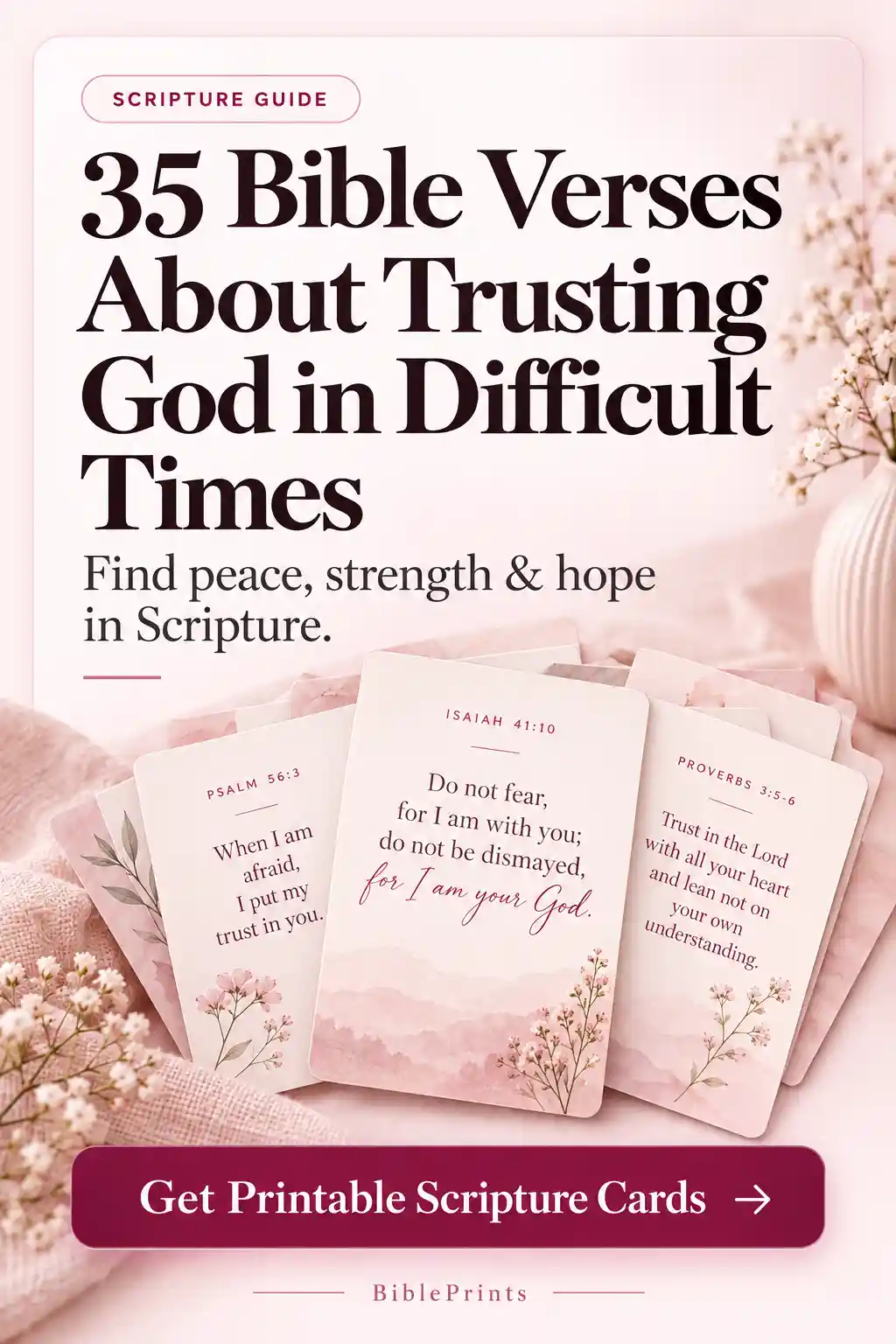
35 Bible verses about trusting God
These passages are arranged as a practical reference. Each card gives the main biblical emphasis and the situation where that emphasis may be most useful.
Proverbs 3:5–6
Key idea: Trusting God begins by refusing to make your own understanding the final authority. The passage calls for wholehearted trust and active acknowledgment of God in the way you choose.
Best for: When you need direction but cannot see the whole path.
Psalm 56:3–4
Key idea: David does not pretend fear never comes. He shows what to do when it does: deliberately turn fear into trust and anchor confidence in God.
Best for: When fear is loud and you need a short verse to return to.
Isaiah 26:3–4
Key idea: Isaiah connects steady peace with a mind fixed on God. Biblical trust is not empty positive thinking; its object is the Lord’s enduring strength.
Best for: When anxious thoughts keep circling.
Psalm 28:7
Key idea: David joins trust with dependence: God is described as strength and shield, and the response is grateful praise rather than self-reliance.
Best for: When you need help and protection.
Isaiah 41:10
Key idea: God’s answer to fear in this passage is His presence, help, strength, and sustaining hand. The emphasis is not on personal toughness.
Best for: When you feel alone, weak, or intimidated.
Joshua 1:9
Key idea: Joshua receives courage for a real responsibility because God promises to be with him. The verse is about faithful obedience in the presence of God, not guaranteed ease.
Best for: Before a difficult step or responsibility.
Psalm 112:7
Key idea: This psalm describes a heart made firm by trust in the Lord. It does not promise that bad news never arrives; it shows where stability comes from when it does.
Best for: When you are waiting for news or fearing an outcome.
Psalm 62:8
Key idea: Trust and honesty belong together. The psalm invites God’s people to pour out their hearts because God is a refuge, not because they have no painful feelings.
Best for: When you need to pray honestly instead of pretending.
Jeremiah 17:7–8
Key idea: Jeremiah pictures the trusting person like a tree near water that can remain green even in heat. The image is resilience rooted in God, not a life without drought.
Best for: When circumstances stay difficult for a while.
Psalm 37:5
Key idea: Trust includes handing your way to God, not merely thinking reassuring thoughts. Commitment and trust belong together.
Best for: When you need to surrender a plan or next step.
Romans 8:28
Key idea: Paul’s promise is addressed to those who love God and are called according to His purpose. It does not label every painful event good; it points to God’s ability to work within a larger purpose.
Best for: When you are trying to understand a painful or confusing season.
Proverbs 16:3
Key idea: This proverb joins work with surrender. Planning is not condemned; the invitation is to entrust what you do to the Lord.
Best for: When starting a project, decision, or new season.
Proverbs 16:9
Key idea: Human beings make real plans, yet Scripture keeps God’s direction in view. Trust makes room for course correction.
Best for: When plans change unexpectedly.
Psalm 9:10
Key idea: The psalm connects trust with knowing God’s name and character. Trust grows from who God is, not from certainty about every outcome.
Best for: When you want a deeper reason to trust.
Psalm 46:1–2
Key idea: God is described as refuge, strength, and present help in trouble. The passage does not deny shaking circumstances; it locates security in God within them.
Best for: When life feels unstable.
Psalm 91:1–2
Key idea: The psalm uses shelter and fortress language to express dependence on God. Read the whole psalm as poetry of trust rather than as a formula for avoiding every danger.
Best for: When you need refuge imagery for prayer or reflection.
Psalm 118:8
Key idea: This verse compares trust in the Lord with placing ultimate confidence in people. Human support matters, but it cannot carry the weight of final trust.
Best for: When disappointment in people has shaken you.
Psalm 143:8
Key idea: David asks to hear of God’s steadfast love and to be shown the way he should go. Trust here is both relational and directional.
Best for: For a morning prayer when you need guidance.
John 14:1
Key idea: Jesus speaks to troubled disciples and calls them to faith. The context is uncertainty and coming loss, which makes the invitation especially meaningful in unsettled seasons.
Best for: When your heart feels troubled by change.
John 14:27
Key idea: Jesus distinguishes His peace from the world’s peace. Christian trust does not depend on circumstances becoming predictable first.
Best for: When you need Christ-centered peace.
Hebrews 13:8
Key idea: This short statement points to the unchanging identity of Jesus Christ. It gives faith a stable center when circumstances and emotions are changing.
Best for: When everything around you feels unstable.
Romans 15:13
Key idea: Paul’s prayer links believing with joy, peace, and hope through the Holy Spirit. Trust is not isolated from hope; it nourishes it.
Best for: When discouragement is draining your hope.
2 Corinthians 5:7
Key idea: Paul describes Christian life as walking by faith rather than sight. The verse is not an excuse to ignore evidence; it says visible circumstances are not the whole basis of Christian confidence.
Best for: When you cannot yet see how a situation will resolve.
Mark 5:36
Key idea: Jesus speaks into a moment of devastating news with a call away from fear and toward faith. The verse belongs to a specific story, so it should not be turned into a promise that every crisis ends the same way.
Best for: When fear wants to control your response.
Deuteronomy 31:8
Key idea: Moses reminds Israel that the Lord goes before His people and does not forsake them. Trust here rests on God’s presence in transition.
Best for: When entering a new or uncertain season.
Lamentations 3:22–24
Key idea: These words arise from grief, not comfort. Hope is rebuilt by remembering God’s mercy and faithfulness in the middle of lament.
Best for: When waiting has become exhausting.
Isaiah 12:2
Key idea: Isaiah gives a concise confession of trust that connects God with strength and salvation. It works well as a short prayerful reminder.
Best for: When you want a brief declaration of trust.
Psalm 121:1–2
Key idea: The psalm lifts attention from the hills to the Lord, Maker of heaven and earth. Its movement is from anxious looking to clear dependence.
Best for: When you need to remember where help ultimately comes from.
Psalm 32:10
Key idea: The psalm contrasts the sorrows of the wicked with steadfast love surrounding the one who trusts the Lord. Trust is held within mercy, not perfectionism.
Best for: When guilt or failure makes it hard to approach God.
2 Samuel 22:31
Key idea: David praises God’s way and word and describes Him as a shield to those who take refuge in Him. The image emphasizes tested faithfulness.
Best for: When pressure makes you feel exposed.
James 1:5–6
Key idea: James tells believers who lack wisdom to ask God. Trust can look like praying for wisdom before acting rather than demanding certainty first.
Best for: When you need clarity for a decision.
Nahum 1:7
Key idea: Nahum names the Lord as good and as a stronghold in the day of trouble. The verse holds together God’s character and His care for those who take refuge in Him.
Best for: When you need a compact reminder of God’s goodness in trouble.
1 Peter 5:7
Key idea: Peter directs believers to cast their anxieties on God because He cares for them. The action is relational: concerns are handed to a caring God.
Best for: When worry keeps returning.
Philippians 4:6–7
Key idea: Paul redirects anxiety toward prayer, specific requests, and thanksgiving, followed by the promise of God’s peace guarding heart and mind in Christ.
Best for: When you need a concrete prayer pattern.
Psalm 20:7
Key idea: This psalm contrasts confidence in visible power with remembering the name of the Lord. It is a clear picture of choosing the object of your trust.
Best for: When outward resources seem more reliable than faith.
Bible verses about trusting God in difficult times
For difficult times, begin with Psalm 62:8, Isaiah 41:10, Jeremiah 17:7–8, Psalm 46:1–2, and Psalm 56:3–4. Together they make an important point: biblical trust does not require emotional numbness. Psalm 62:8 explicitly makes room for pouring out the heart, while Jeremiah 17 pictures stability that remains even when the “heat” is still present.
If difficult circumstances are leaving you mentally overloaded, this guide to Bible verses for feeling overwhelmed focuses more specifically on heaviness, pressure, and finding a place to bring it.
Bible verses about trusting God in hard times
Jeremiah 17:7–8 is one of the clearest images for hard times because the tree still experiences heat; what changes is the location of its roots. Lamentations 3:22–24 is equally important because its language of mercy and faithfulness appears in a book of grief. Neither passage treats suffering as trivial.
For seasons where hardship is also connected with physical weakness or recovery, see Bible verses for healing and strength for a more focused set of passages.
Bible verses about trusting God’s plan and timing
When the plan is unclear
Proverbs 3:5–6, Romans 8:28, Proverbs 16:9, and James 1:5–6 are strong starting points. They emphasize trust, purpose, direction, and wisdom without promising that you will understand every detail immediately.
When the timing feels slow
Psalm 37:5 and Lamentations 3:22–24 help shift attention from controlling the timeline to remembering God’s character and continuing faithfully in the present.
Bible verses about trusting God instead of fear
Psalm 56:3–4, Isaiah 41:10, Psalm 112:7, Isaiah 26:3–4, and John 14:1 are especially relevant when fear is the central problem. Notice that Scripture often does not begin by shaming fear; it redirects the frightened person toward God’s presence, character, and word.
If the deeper issue is self-doubt, courage, or confidence, read Bible verses about confidence, which distinguishes confidence rooted in God from confidence built only on personal ability.
New Testament Bible verses about trusting God
The New Testament continues the trust theme through faith in Christ, prayer, hope, and dependence on God’s wisdom. Good starting passages include John 14:1, John 14:27, Romans 8:28, Romans 15:13, 2 Corinthians 5:7, Hebrews 13:8, James 1:5–6, 1 Peter 5:7, and Philippians 4:6–7.
10 biblical reasons to trust God
| Reason | Scripture | What it contributes to trust |
|---|---|---|
| God’s character is good | Nahum 1:7 | Trust begins with who God is, not with predicting outcomes. |
| God gives wisdom | James 1:5–6 | You can ask for direction instead of pretending certainty. |
| God is present in trouble | Psalm 46:1–2 | Difficulty does not imply abandonment. |
| God strengthens the fearful | Isaiah 41:10 | Courage can rest on God’s help rather than self-confidence. |
| God can direct your path | Proverbs 3:5–6 | Trust provides a posture for decisions when understanding is limited. |
| God’s mercy remains in grief | Lamentations 3:22–24 | Hope can be rebuilt by remembering faithfulness in lament. |
| God cares about your anxiety | 1 Peter 5:7 | Worry can be brought to God relationally. |
| God hears honest prayer | Psalm 62:8 | Trust includes pouring out the heart, not hiding it. |
| Christ remains the same | Hebrews 13:8 | Faith has a stable center when circumstances move. |
| God can work within a larger purpose | Romans 8:28 | Pain is not called good, but it is not beyond God’s redemptive purpose. |
Short Bible verses about trusting God to remember
If you want a compact reference for a journal margin, prayer card, or memory practice, start with Psalm 56:3, Isaiah 12:2, Psalm 118:8, Psalm 37:5, Proverbs 16:3, 2 Corinthians 5:7, and Nahum 1:7. Shortness is useful, but context still matters—memorize the reference and read the surrounding passage as well.
How to trust God in difficult times
Trust is not a switch you flip once. Scripture presents it as a repeated posture of prayer, remembrance, dependence, and obedience.
Use Psalm 62:8 as a model for honesty rather than vague religious language.
Fear, indecision, grief, waiting, and bad news are different pressures; use the chooser above instead of forcing one verse into every situation.
Ask who is speaking, what situation is being addressed, and what the passage actually promises.
Instead of repeating a slogan, tell God what you do not understand and ask for the help, wisdom, peace, or courage the passage points toward.
Trust is compatible with planning, counsel, practical action, and asking for help.
A journal note, printed Scripture card, or phone reminder can support memory; the object is not the source of strength—the biblical truth it points back to is.
What trusting God does—and does not—mean
Trust can include
Honest prayer, wise planning, waiting, asking for counsel, admitting fear, seeking help, obeying what is clear, and returning attention to God’s character.
Trust does not require
Pretending pain is good, ignoring danger, refusing practical help, suppressing every emotion, predicting a specific outcome, or using a verse as a guarantee that hardship will end on your preferred timeline.
A short prayer for trusting God
God, You know what I understand and what I cannot see yet. Help me bring You my fear honestly, ask for wisdom where I need it, and take the next faithful step without demanding control of the whole path. Keep my mind anchored in Your character and teach me to trust You with what I cannot resolve today. Amen.
Frequently asked questions about trusting God
How do I trust God in difficult times?
Start by bringing the difficulty to God honestly, choosing a passage that addresses the actual pressure, reading it in context, praying specifically, and taking the next faithful step you can see. Psalm 62:8 is especially useful because it joins trust with pouring out the heart.
What is a good Bible verse about trusting God?
Proverbs 3:5–6 is a strong starting passage because it directly contrasts wholehearted trust in God with relying only on your own understanding and then connects trust with direction.
What is a short Bible verse about trusting God?
Psalm 56:3 is one of the shortest trust references to remember because it places trust directly alongside fear. Isaiah 12:2 and Psalm 37:5 are other compact options.
What Bible verse helps when I am afraid of bad news?
Psalm 112:7 is especially relevant because it describes a person who is not ruled by fear of bad news because the heart is firm in trusting the Lord.
What does Proverbs 3:5–6 mean in context?
Proverbs 3:5–6 teaches wholehearted reliance on God rather than making personal understanding the final guide. In the surrounding wisdom teaching, acknowledging God shapes the way a person walks rather than eliminating the need for wise action.
Does trusting God mean ignoring my problems?
No. Biblical trust includes honest lament, prayer, wisdom, and action. Psalm 62:8 invites people to pour out their hearts, while James 1:5 tells those who lack wisdom to ask God.
Which Bible translation should I use for a trust verse card?
Use a translation you can quote legally and accurately. BiblePrints prefers reference-plus-original-explanation for articles and defaults to a clearly labeled public-domain translation such as the World English Bible when an exact quotation is needed.
About this BiblePrints Scripture guide
This resource was created to help readers move from a broad search for “trusting God” to a passage that fits a specific need such as fear, uncertainty, hard times, changed plans, waiting, or the need for wisdom. Verses were selected for direct relevance to trust, dependence, refuge, faith, courage, prayer, and God’s presence. Explanations are written in original wording, and readers are encouraged to read every passage in its surrounding biblical context.
BiblePrints is a Christian Scripture and printable Bible resource website. Learn more on the About BiblePrints page.
Read the passages in full
For verification and deeper study, read the whole chapter rather than relying only on an isolated reference.
You do not have to understand the whole road before you take the next faithful step. Choose one passage that tells the truth about the pressure you are carrying, read it in context, and let it shape the next prayer you pray.